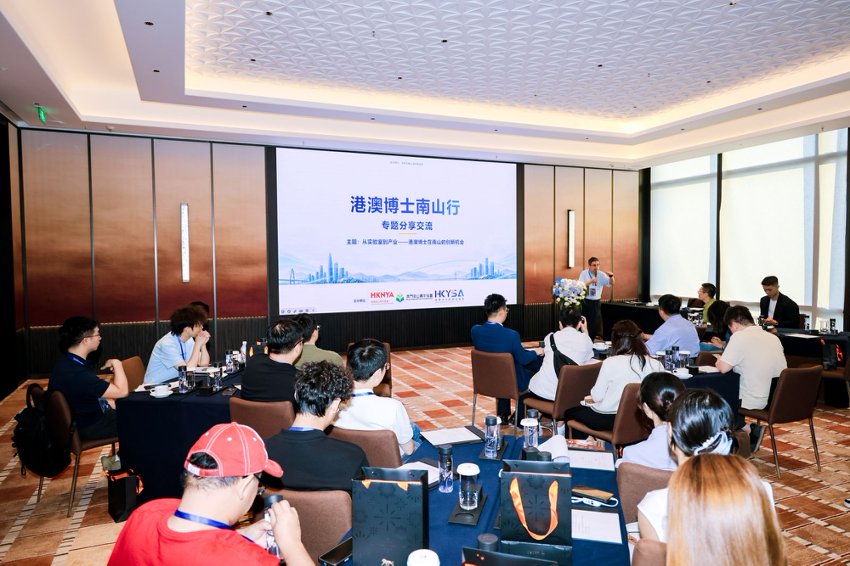
Hong Kong and Macao Doctoral Visit to Nanshan: A Detailed Account
On 19 September 2026, the Hong Kong and Macao Doctoral Visit to Nanshan took place in Nanshan, Shenzhen. The organisers confirmed that 30 doctoral participants attended, including PolyU Assistant Professor Feng Siyuan and Dr Cheng Li. The group visited Shenzhen InnoX, the Shenzhen Foundation Model AI Eco-Hub and the Global Service Centre, and officials from the Nanshan Talent Bureau were invited to explain talent-related information. A subsequent discussion began to connect the platforms encountered during the visits with participants’ own research, products and entrepreneurial plans.
Some projects were looking for their first application setting. Some teams were considering relocating a company to Nanshan, while others were already conducting research there and hoped to stay after graduation. Their contributions pointed to practical questions about establishing a project: who can provide data, who is willing to test a prototype, where the R&D team should be based, and how research and entrepreneurship can progress in an appropriate sequence.
From platform visits to project discussions
Shenzhen InnoX, the Shenzhen Foundation Model AI Eco-Hub and the Global Service Centre address different aspects of project development. The pre-visit plan identified hard technology entrepreneurship training and incubation, the AI innovation ecosystem, and services for companies expanding globally as priorities. The visits gave participants direct exposure to these platforms; the discussion clarified where follow-up engagement could begin.
Moving hard technology out of the laboratory still requires product definition, engineering and customer validation. AI projects must address models and computing resources while also fitting into real business processes. Cross-border cooperation brings questions of company arrangements, intellectual property and professional services. Teams connecting Hong Kong and Macao research with mainland industry often need to consider these issues together, beginning with a clearly defined task and progressing step by step.
The explanation of talent-related information was another important part of the visit. Developing a career or venture in Nanshan can involve personal employment, research and living arrangements, as well as a company’s premises, team, R&D and market needs. Applicable policies must be checked against the individual’s status and experience, the applicant entity’s circumstances, and the application period. Clarifying how someone intends to work in Nanshan makes it easier to identify relevant services. Participation in an exchange does not itself establish policy eligibility.
Leads involving existing Nanshan activity still need verification
During the discussion, a team researching dynamic recognition in streaming long-form video described a solution combining cameras with local computing. It reported having joined a branch associated with the Shenzhen Foundation Model AI Eco-Hub. The registration materials also contained a venture involving local video semantic search, automated editing and privacy protection. These descriptions provide leads worth checking, but differences in transcribed names, university affiliations and product scope mean their relationship still needs to be confirmed with the people concerned.
If evidence substantiates the team’s Nanshan operations, the next focus should be product validation, customers and team development. References during the discussion to talent recognition, investment due diligence and industry partnerships are currently retained only as the team’s own account. They do not establish that an investment has closed or policy funding has been received. Services for projects with existing activity should be organised around actual operations and product progress.
A doctoral student working on fibre-optic endoscopic imaging also said that they had begun research at a PolyU research platform in Nanshan in June or July that year, and intended to remain in Nanshan after graduation. This suggests an existing research connection, but research activity, future personal plans and company formation should remain distinct. Further engagement could focus on the prototype, imaging performance and the conditions for collaboration between medicine and engineering, helping identify a sustainable route to research commercialisation.
Projects with explicit incorporation or relocation plans
Robot perception and manipulation of transparent, reflective and complex-material objects was one of the more detailed leads in the materials. Combining polarisation and hyperspectral imaging, edge AI and robot control, the project described itself in the registration submission as being at TRL 4. Its representative reported an existing prototype during the discussion, expressed an intention to incorporate in Nanshan, and sought funding, R&D premises and supporting resources.
A product demonstration and interviews with potential users would be useful first steps. Grasping transparent components, highly reflective parts and complex materials presents specific challenges in manufacturing or laboratory automation. Identifying the shortcomings of customers’ existing approaches, then comparing prototype performance in terms of task success rate, processing speed, cost and reliability, would create a shared basis for technical assessment and industry engagement. Both the incorporation intention and prototype status still need to be checked with the person concerned and supporting materials.
An embodied robotics project for the power sector described another route. The speaker reported having rented office space in Nanshan and outlined a schedule for personal household registration and company relocation by the end of the year. A closely similar power-sector robotics project appeared in the pre-visit registration materials, but the AI notes contained differences in the transcription of the speaker’s name. The records should therefore be combined only after personal confirmation. Renting an office, obtaining personal household registration and relocating a company are separate matters and should be followed up separately. Future plans must not be recorded as completed actions.
A project addressing women’s health across the life course expressed a need to pursue commercialisation in Nanshan. The presentation referred to multiple sensing technologies and applications during pregnancy, menstruation and preparation for conception. The team reported that it had incorporated a company in Hong Kong and was conducting multi-centre clinical validation. This is a commercialisation lead that merits an early interview, but the project entity, development stage and validation evidence still require verification. Engagement should begin with the target product, intended applications and division of R&D responsibilities. The health applications described in the presentation should not be reported as proven clinical benefits.
Teams seeking research and career connections first
A speaker working on efficient large models and on-device deployment said their immediate priority was to find an academic position before pursuing entrepreneurship. The registration materials also indicated technical work in model compression, sparse computation and lightweight deployment. Both the technology and entrepreneurial interest warrant follow-up, but the sequence should respect the person’s plans: first clarify the research role, ownership of outputs and cooperation arrangements, then discuss whether and when to form a company.
The needs raised in industrial predictive maintenance were more closely tied to application conditions. The research sought to use AI for industrial fault monitoring in systems including high-speed rail, aviation equipment and ageing lifts. The speaker wanted access to industry settings and data. A useful next step would be to select one type of equipment or operating condition, define data availability, what constitutes a fault, the desired advance warning and a pilot period, and connect algorithm evaluation with the user’s costs and benefits.
Other research areas raised during the discussion included drug development, AI in pharmaceuticals and digital asset inheritance. Some speakers expressed preliminary ideas about starting a business in Nanshan; others remained focused on research cooperation. For leads without a defined product or team, a one-page description of the research outputs and needs would be more useful. Commercial maturity should not be inferred from a subject label, and not every researcher needs to be counted as an entrepreneurial project.
AI services need clear customers and validation methods
A contribution on enterprise AI agent security and privacy covered auditing, compliance and services for mid-sized businesses, with a proposed arrangement combining a Hong Kong entity and Shenzhen R&D. The existing notes did not specify that the Shenzhen R&D location would be Nanshan. The person’s location preference should be confirmed before discussing customers, product scope, data access and delivery. There is not yet sufficient evidence to substantiate claims of product leadership or an industry first.
AI entrepreneurship education and learning assessment formed another clear area of interest. Registration and discussion materials covered courses for different education levels, informatics training, entrepreneurship and product design education, and proposed curriculum development and pilots with universities, secondary schools and companies. Relevant teams reported having existing companies, but whether they operate in Nanshan and what additional business they plan to develop still need separate confirmation.
For an education platform or entrepreneurship analysis tool, work could begin with one course, one partner school or one cohort of entrepreneurial projects. The users, data and evaluation methods should be defined first. At the end of the pilot, changes in learning outcomes or work efficiency can be assessed before expanding cooperation. Other registered projects in educational study visits, career development, research management and pitch analysis could similarly seek their first partners through specific, manageable tasks.
Connecting cross-border resources and follow-up services with projects
Discussion relating to cultural tourism and Macao added perspectives on applications and cross-border cooperation. Technology can support cultural and tourism experiences, while also needing to account for how people actually use and experience it. Macao may offer some projects a starting point for understanding cross-border demand and accessing resources, but the business itself must still be designed around target customers and market conditions. Institutional experience and past performance mentioned at the event have not been used as project endorsements where they remain independently unverified.
During the discussion, the organisers offered to consolidate projects with a clear intention to establish operations and assist with contacts to relevant departments. This is an arrangement for subsequent resource connections. Formal applications must still follow the policies and procedures published by the responsible authorities. Service commitments made during the exchange do not mean exemption from assessment, guaranteed funding or the creation of a new formal administrative channel.
The suggested next step is to identify one question, one supporting document and one action for each lead. Projects reporting existing Nanshan activity should provide evidence of the entity and actual operations. Those planning incorporation or relocation should clarify timing, team and business arrangements. Teams preparing joint R&D should define technical and pilot conditions. Where names or content may have been transcribed incorrectly, the event contact should first check with the person concerned, preventing different projects from being combined during follow-up.
The visit generated project leads that can now be developed further. Results will need to be demonstrated through product validation, pilot cooperation, company incorporation or relocation, and actual operations. Matching prepared teams with suitable application settings, and helping researchers who are still exploring to clarify their next step, can extend the visit’s contribution to connecting talent with industry.
Evidence note: The organisers confirmed the event date, actual itinerary, talent information session, attendance of 30 doctoral participants, and participation by Feng Siyuan and Cheng Li. Project content was compiled from their supplied AI-generated discussion notes for 17:28–18:06 on 19 September 2026, the registration questionnaire and pre-visit materials. The AI notes are not a verbatim transcript of the original audio. This account describes projects anonymously and uses no unverified direct quotations. Existing activity, plans and analytical suggestions remain distinguished according to the stage indicated in the materials.