 monica
CREATIVE NOTES / Art & making
Following the Lines of Monica’s Black-and-White Landscape
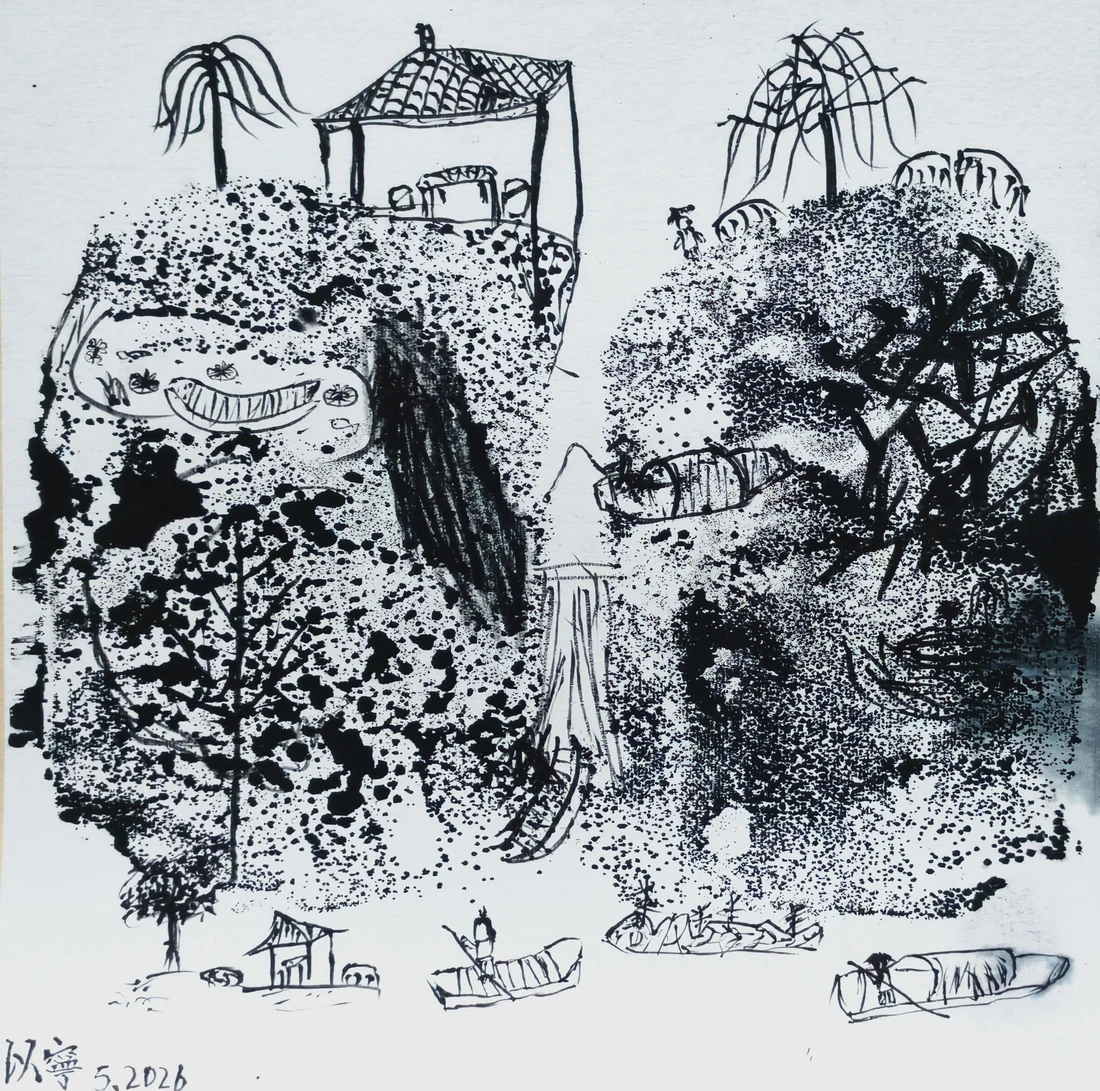
Monica’s Landscape in Black & White builds its scene without a broad palette. Roofs, hanging branches, small boats and waterways find their places in black marks and unmarked paper. The artwork is dated May 2026. Start by finding familiar objects, then notice how different arrangements of dark marks change the weight and spacing of the scene.
Begin with a route through the picture
Boats and waterways offer a way into the composition. Try beginning with a boat near the lower edge, following a lighter opening upwards, and then looking for houses and trees. This is a route chosen by the viewer, rather than an itinerary stated by the artist. It gives the busy surface useful landmarks: something to approach, somewhere to pause and another part of the picture to discover next.
Dense marks and open spaces
Clusters of black dots sit alongside darker trunks and small roof details. Enlarge the photograph and compare these marks rather than treating every dark area as one surface. Dense patches can feel visually heavier, while more open areas give the eye a pause. This is a way of reading the composition: connect an impression to something visible, without needing to assign a fixed meaning to every patch of texture.
Different lines describe different things
The roofs and edges of walls have a different character from the branches hanging down beside them. One offers corners and changes of direction; the other stretches into longer curves. Boats introduce another rounded outline. Compare a few of these details to see how varied lines describe familiar things. Recognisable objects give the marks a purpose and make the landscape feel inhabited, even though the palette remains restrained.
Try a small study of your own
For a small exercise, draw a tree, a house and a waterway, then choose two kinds of marks, such as dots and short strokes. Look at the result from a distance before moving closer. Ask which area attracts attention and which might benefit from more space. The exercise takes its cue from close observation, leaving you free to invent a different setting and arrangement rather than reproduce Monica’s composition.
Two more questions
When was this landscape made?
The artwork page records May 2026 from the inscription visible on the drawing. This is the date on the work, rather than the date it was uploaded.
What should I look at first in a monochrome drawing?
Find familiar shapes such as a house or boat, then compare lines and the density of dots. Specific observations make it easier to explain which part you enjoy and why.
Explore the works in this note
Profile information was supplied by her family. These notes were prepared by the Monica portfolio editorial team from the original works, performance records and playable projects on this site, with AI-assisted writing and translation. Descriptions of existing work are distinguished from activities readers may try. The articles are editorial introductions, not first-person accounts written by Monica.
Profile and editorial notes →