 monica
CREATIVE NOTES / Coding & playful learning
The colours she wanted to play with: Monica’s Crystal Blocks story
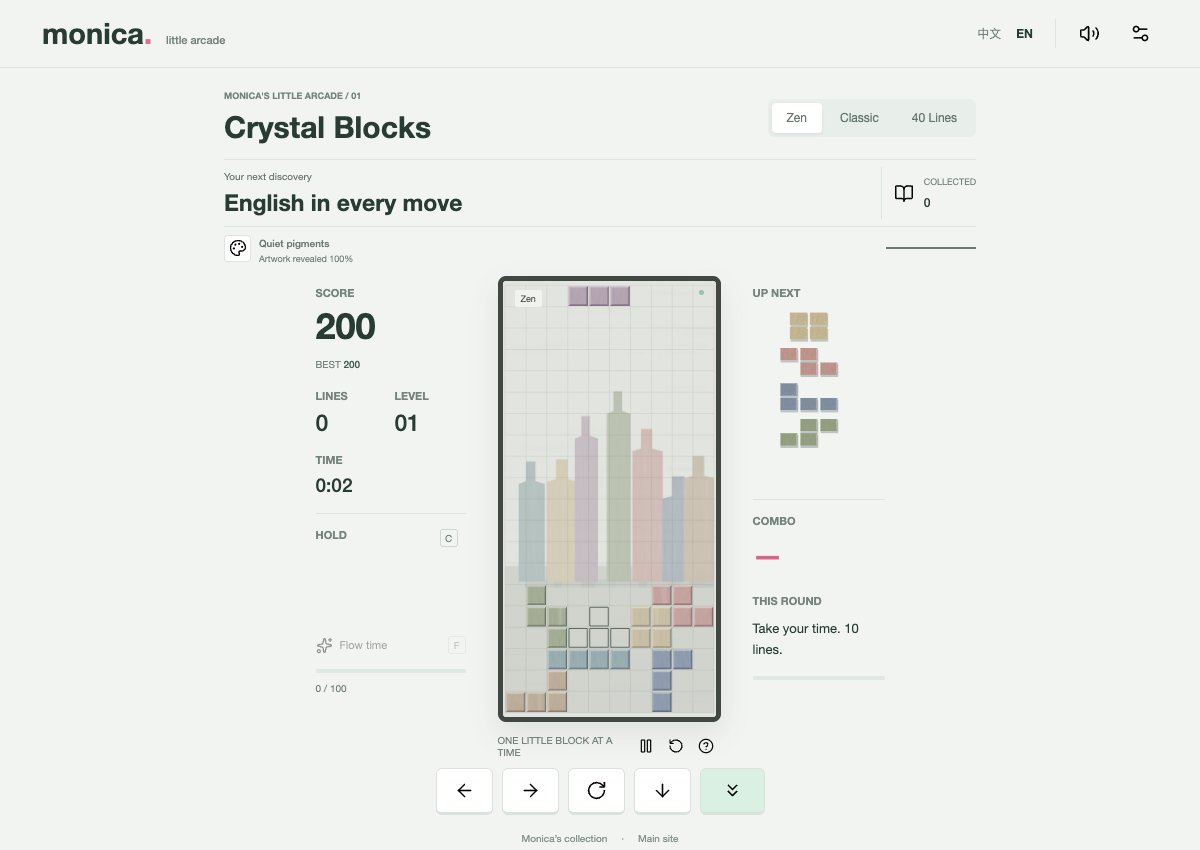
When designing Crystal Blocks, Monica was thinking beyond filling a row. She wanted the pieces to use the Morandi colours she liked, considered Mondrian’s geometric compositions and Zao Wou-Ki’s meeting of Eastern and Western artistic sensibilities, then added another question: could playing also introduce words such as block and eliminate? These interests gave the falling-block game a personal creative direction.
An exhibition left her with colours she liked
As a younger child, Monica visited a special Morandi exhibition and liked its low-saturation colours. When she began designing a game, that experience offered something she wanted to use: could colours admired in paintings become the colours of falling pieces? The connection is small but meaningful. A preference acquired while looking at art became a question about making something. Choosing a palette was now part of the game’s design, giving a remembered exhibition a place in a different medium.
From colour to the way a picture is organised
Her questions extended from colour to composition. Since the game was made of blocks, how might Mondrian-like grids, lines and colour areas fit it? What different atmosphere might emerge from her interest in Zao Wou-Ki’s combination of artistic traditions? These references suggested different possibilities: a palette, a way of organising shapes, and a layered visual mood. Monica wanted to bring those interests into one playable work. Art became something to think with while designing the experience, as well as something to look at.
An idea becomes something a player can choose
The published art edition gives those directions specific controls. Quiet pigments uses a Morandi palette; Primary order draws on Mondrian-inspired composition; Ink & horizons offers a Zao Wou-Ki-inspired atmosphere. Players can change the style, adjust artwork intensity, request a new composition or reveal the picture gradually through cleared lines. The compositions are generated by the program, with related colours and surfaces across the artwork and pieces. In this project, Monica’s hands-on coding and AI-assisted creation give her artistic questions a response that visitors can actually try.
When a row disappears, could a word stay?
Monica also proposed linking play with word memory, using block and eliminate as examples. The current English-learning journey provides meanings, example sentences, illustrations, speech and review. Eliminate is already a separate lesson entry, connected to removing a full row. Block appears in relevant sentences, although it is not currently a standalone entry. Falling, rotating and clearing provide concrete contexts for language. Her intention is to make a game that is enjoyable while leaving room to encounter something new; the learning features turn that intention into activities players can use.
The questions are visible in today’s game
Open Crystal Blocks today and choose an art style before starting Zen, Classic or 40 Lines mode. Notice the palette and surfaces, watch an image emerge as rows clear, or save the artwork. Learning-card frequency can also be adjusted or turned off for uninterrupted play. Together, these choices connect a remembered exhibition, artistic associations and a wish to include learning. The result offers visitors a set of rules to play with and a set of decisions through which to understand the young creator’s interests.
Two more questions
Are the game images original paintings by those artists?
No. The themes reference palettes, composition and atmosphere. The program generates original compositions rather than reproducing an existing painting.
Are block and eliminate both standalone lessons?
Eliminate has its own entry. Block was one of Monica’s examples and currently appears in sentences, but is not a separate entry.
Explore the works in this note
Further reading on the art
The creative background was supplied by her family in October 2026. These sources offer context on the three artists.
Profile information was supplied by her family. These notes were prepared by the Monica portfolio editorial team from the original works, performance records and playable projects on this site, with AI-assisted writing and translation. Descriptions of existing work are distinguished from activities readers may try. The articles are editorial introductions, not first-person accounts written by Monica.
Profile and editorial notes →