 monica
CREATIVE NOTES / Art & making
Blue and White Cloth: Follow the White Space and a Fold
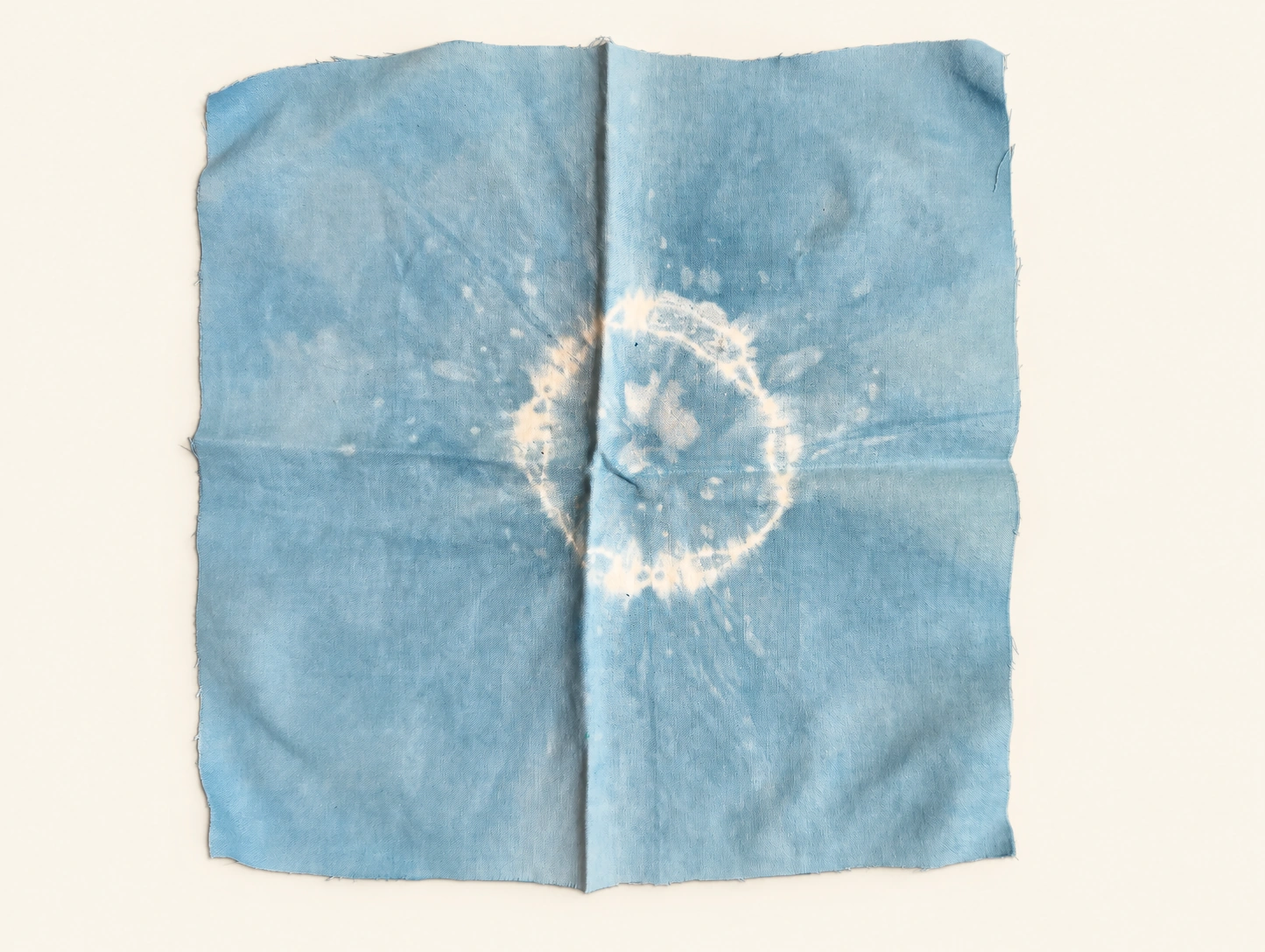
The first thing you notice on a blue cloth might be the part that is hardly blue at all. A broken white ring sits near the centre of this textile work by Zhan Yining, also known as Monica, with smaller pale marks across a light blue field. This editorial observation follows the white space to practise looking at contours and recognising uncertainty. A Hong Kong primary pupil’s portfolio can be a starting point for careful attention to a small piece of material.
White can carry the pattern
At a smaller viewing size, blue reads as one broad field and the white pattern draws attention towards the centre. Up close, the ring is not a line of constant width: some parts spread out, some resemble short radiating marks, and pale patches remain inside. Here, white space means the lighter areas that stand out against the blue. Using that visual description does not establish which tool or process produced those areas.
Trace a contour without touching the work
Try tracing the outer contour in the air, starting at the top and moving around towards the starting point. Where does the direction change abruptly? Where would you have to cross blue to keep going? Before calling it a sun or a flower, describe it as roughly ring-shaped, interrupted at its edge and not identical on both sides. Those details help another person picture the work while keeping a visual observation separate from an imaginative association.
Folds introduce another set of lines
Vertical and horizontal folds cross the photograph, with noticeable light and shade around their intersection. A pale pattern edge and a fold shadow can both look like lines, but they should not automatically be treated as the same thing. Select a short segment and ask whether you are seeing a colour boundary or shading from the fabric surface. If this photograph is insufficient to tell, leave the answer open. A dark-looking patch is not necessarily a more strongly dyed patch.
An association is not a making record
The edges retain small irregularities and a fibrous appearance, while the blue varies in shade. These are worth noticing, but they do not tell us the tying method, dye name, soaking time or making date. The original work page records textile craft and leaves the creation date unspecified. Establishing a particular method would require process photographs or further family confirmation. AI-assisted editorial writing cannot supply missing original evidence.
Turn the observation into a new exercise
On a separate sheet, draw an incomplete ring and try a narrow border, a broad border and short separated marks. Compare which version holds your attention near the centre. You might also gently fold that paper once and observe how the fold shading changes your reading of the same pattern. This is a suggested activity for readers, not a record of Monica’s process. Returning to find one previously unnoticed pale mark is a more concrete response than assigning the work a grand stylistic label.
Two more questions
Can the exact dyeing method be identified?
No. The photograph and work page support an observation of the blue-and-white pattern and fabric appearance, but do not document tools, dye or steps.
Why distinguish folds from colour?
A fold shadow may resemble a dark line. Distinguishing the two helps avoid treating photographic shading as part of the colour design.
Explore the works in this note
Profile information was supplied by her family. These notes were prepared by the Monica portfolio editorial team from the original works, performance records and playable projects on this site, with AI-assisted writing and translation. Descriptions of existing work are distinguished from activities readers may try. The articles are editorial introductions, not first-person accounts written by Monica.
Profile and editorial notes →