 monica
CREATIVE NOTES / Art & making
A Frame Full of Cats: Finding Colour and Expression in Monica’s Puzzle
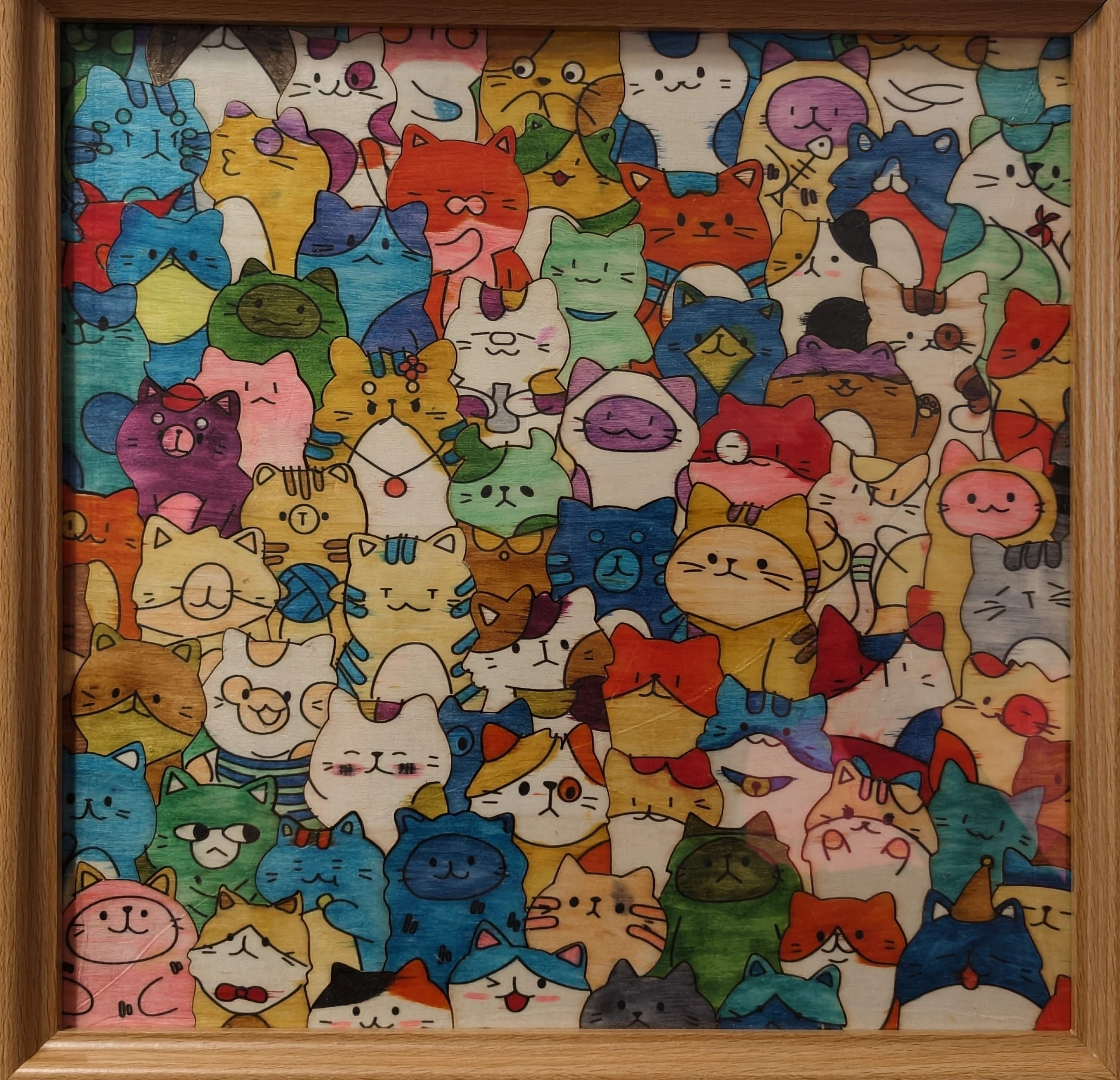
Open the photograph and the colours arrive first; individual cat faces emerge as you look longer. Cat Puzzle & Coloring, recorded in the portfolio of Zhan Yining (詹以宁), also known as Monica, gathers many cats within a wooden frame. Some have round eyes, others narrow eyes or large nose-and-mouth shapes. This editorial note reads the completed puzzle and colouring work, following the details that help individual cats stand out within a crowded picture.
Neighbouring colours give the eye a starting point
Near the upper centre-left, a red-orange cat face meets areas of dark and light blue. Looking right brings pale green and yellow into view. Neighbouring colours give the eye places to pause before following the black outlines towards ears and bodies. Blue also appears elsewhere, linking cats across the picture as well as separating nearby shapes. Try starting at one clearly contrasting edge and tracing the form it belongs to. This provides an entry into the crowded arrangement.
A few facial marks can create many differences
The faces use relatively few details. Some eyes are small black dots, others short strokes, and some are conspicuous white shapes. Noses, mouths and whiskers occupy different positions. A purple cat on the left has a prominent pink nose-and-mouth area; elsewhere, a mouth is suggested by a thin line. Choose two similarly sized faces and compare only eyes and mouths. Which marks are rounded or straight, and how far apart are they? These observations describe an expression more precisely than a quick label.
Several colours can belong to one cat
Colour changes also happen within individual cats. Pale-yellow areas appear inside blue forms, while cream faces carry purple or orange patches. An outer outline holds these areas together as one figure; the patches supply additional features to recognise. Looking closer reveals uneven tones and colouring marks within blue or yellow areas, with a different texture from the distinct black lines. Look twice: first at a cat’s overall colour arrangement, then at the marks visible within those colours.
The wooden frame holds the crowd together
The cats are packed closely together, and some figures are only partly visible along the upper and lower edges. Follow an ear tip, cheek or turning body and another cat soon appears. The four wooden edges give this busy field of colour a clear outer boundary. Looking at the whole work and then one corner creates two scales of attention: a crowded group and individual faces that can be described separately. Move between those views without needing to count every figure at once.
A looking game: give one cat three clues
Choose a cat and write three clues: location, colour and a facial feature. Ask another reader to find it in the photograph. Begin with colour alone and see whether several cats fit, then add a position and a specific shape, such as white eyes or a round nose-and-mouth area. Swap roles after finding it. This suggested viewing game uses details that can be pointed out in the image. If the clues lead to different cats, add a more precise description.
Two more questions
Do I need to count every cat before looking closely?
No. One cat, or a neighbouring pair, is enough for comparing colours, outlines and facial features. Return to the whole picture to find where similar details appear again.
Must each figure use just one colour?
Several colour areas can belong to one cat here. In your own exercise, decide which areas will share similar colours and which will change, then check whether the overall shape remains recognisable.
Explore the works in this note
Profile information was supplied by her family. These notes were prepared by the Monica portfolio editorial team from the original works, performance records and playable projects on this site, with AI-assisted writing and translation. Descriptions of existing work are distinguished from activities readers may try. The articles are editorial introductions, not first-person accounts written by Monica.
Profile and editorial notes →