 monica
CREATIVE NOTES / Art & making
Why Does This Clay Puppy Look as If It Is Tilting Its Head?
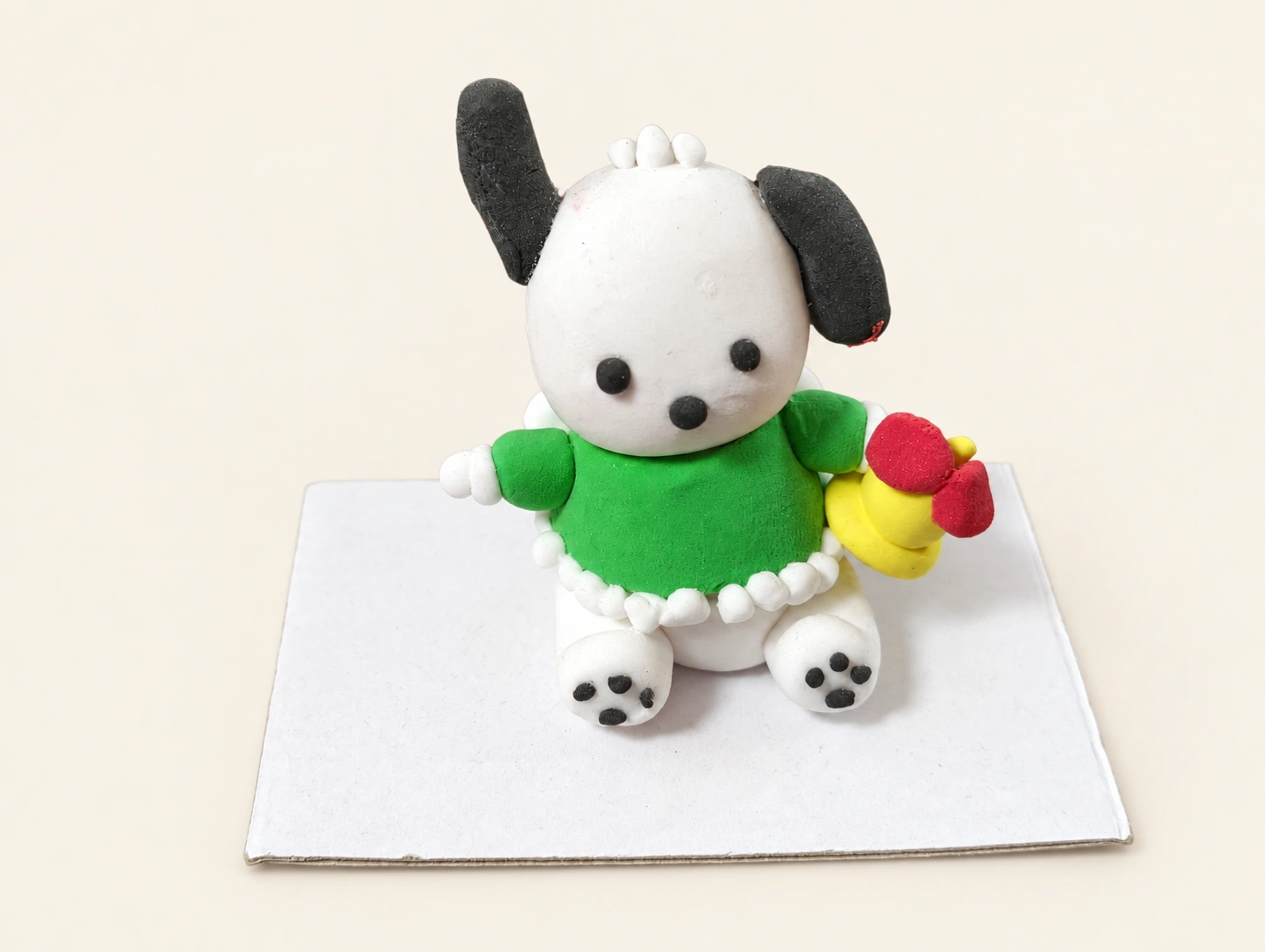
A large white head, a green shirt and two black ears at different heights: this puppy can look as though it is tilting its head to listen. The clay piece, Green-Shirt Puppy, appears in the portfolio of Zhan Yining, also known as Monica. This editorial reading follows what is visible in the photograph, moving from the outline to the size and overlap of its forms.
Start with the ears, without looking for a perfect match
In the photograph, the ear on the left rises above the head, while the one on the right falls beside it. Following the outline takes the eye upwards and then down again. That difference offers one clue to the impression of a tilted head. Their shared black colour connects the ears as a pair; their directions keep the pair from looking identical. Describe their positions first, then consider what pose they suggest.
Read the large head together with its small features
The white head occupies much of the upper figure, but its black eyes and nose are small, leaving plenty of open space across the face. Below it, the green shirt and two forward-facing white feet complete the puppy’s shape. Compare three scales: the whole head, the body and feet, and the tiny facial marks. Moving between them helps explain why a few small details can remain readable within a much larger form.
Overlap gives clues about what sits in front
The head hides part of the shirt’s upper edge, and the feet appear in front of the body. On the right of the photograph, the yellow companion meets the area beside the sleeve. Follow those boundaries: which outline remains visible, and which disappears behind another form? Overlap helps a flat photograph convey depth. The black paw pads face the camera, providing another clue to direction. Together, these relations reveal more than the figure’s green-and-white colours.
Small repeated forms interrupt the larger colour areas
The shirt forms a broad green area, broken along its lower edge by a row of small white pieces. These sit close together without being exactly alike in size or roundness. White bumps above the head and black marks on the feet also place small details within larger shapes. Enlarging the image reveals subtle surface unevenness. Notice where the eye passes across a broad area and where repeated small forms encourage it to pause.
Try two sketches, changing only the ears
Draw a large rounded head and a smaller body, leaving out the face. In one sketch, place both ears at the same height; in the other, raise one and lower the other. Keep the head and body similar in size across the sketches. Write one sentence about the visible difference and another about the pose it suggests. Add the face afterwards and compare again. Use your own imaginary animal for this reader exercise.
Two more questions
Must the ears match for the figure to look well made?
No. Symmetry can suggest neatness, while asymmetry can make a pose more noticeable. Compare the whole figure: how the ears relate in colour, how their directions differ, and how that difference affects your reading of the expression.
How could I photograph my own craft to show its shape?
Keep a full front view and add views from both sides, so viewers can compare changes in outline and overlap. A simple background and space around the edges help. Add a detail view if a join matters, and keep it beside the whole view so its position remains clear.
Explore the works in this note
Profile information was supplied by her family. These notes were prepared by the Monica portfolio editorial team from the original works, performance records and playable projects on this site, with AI-assisted writing and translation. Descriptions of existing work are distinguished from activities readers may try. The articles are editorial introductions, not first-person accounts written by Monica.
Profile and editorial notes →