 monica
CREATIVE NOTES / Art & making
Cube Study: How Three Values Build a Sense of Space
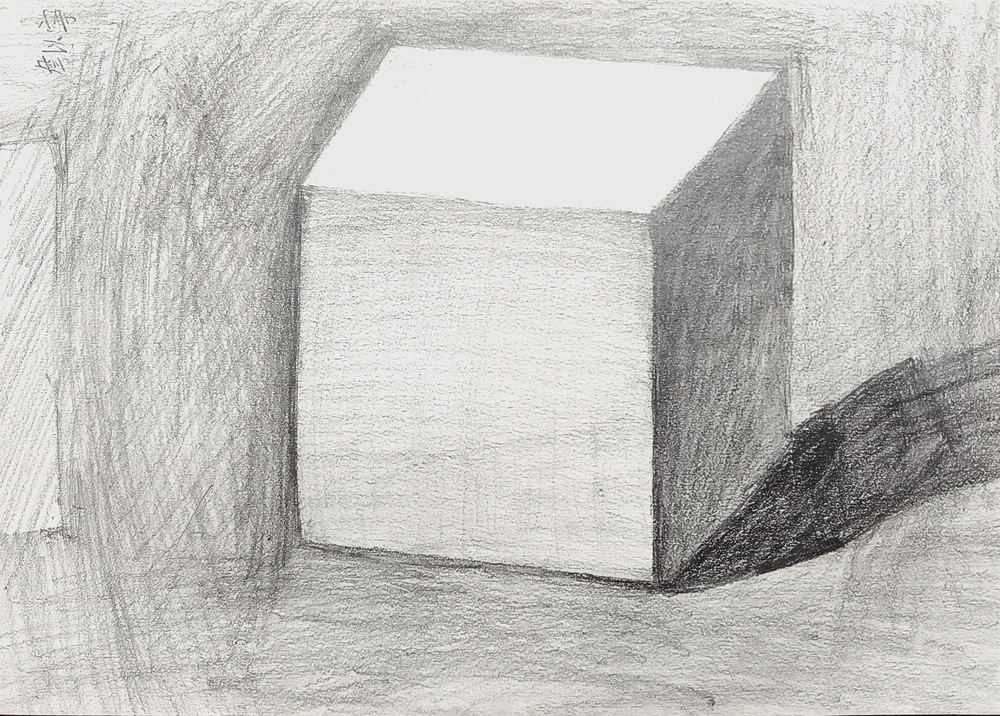
A cube has little surface decoration, so it brings a particular question into focus: why do some pencil marks seem to face us while others turn away? Cube Study by Zhan Yining (詹以宁), also known as Monica, offers a clear example. Three differently shaded faces and a rightward shadow give the outlined form a sense of weight.
Read the faces as three areas of value
The top is the lightest area, close to the tone of the paper. The large face towards the viewer carries a lighter grey, and the right face is noticeably darker. Before counting marks or checking angles, compare these three areas. A sense of volume is already present. Their value relationship is easier to notice at a glance than the straightness of any one edge. In a pencil drawing, differences of lightness can help describe which way a surface appears to turn.
The cast shadow connects cube and ground
A dark shape extends from near the cube’s lower right towards the edge of the picture. Its base meets the lower corner of the form. It sits beside the dark right face, but each belongs somewhere different: one is part of the cube, while the other lies on the surrounding ground. Finding them separately clarifies the space. Follow the shadow outward from that lower corner and notice the connection between object and ground. Contact and the extending shadow help the simple form appear settled on the page.
Hatching gives grey a direction and texture
Viewed closely, the grey areas are not flat fills. Short pencil marks overlap while the paper texture remains visible, and surrounding strokes extend around the cube. Small marks accumulate into a larger tone without losing their individual traces. Compare a small patch on the front with one on the side: where are marks denser, and where does more paper show through? No particular pencil grade needs to be assumed. The visible question is how spacing and overlapping marks create variation within a single medium.
Try a three-value observation exercise
For your own exercise, observe a simple box under steady lighting and begin with three areas: light, middle and dark. Leave out labels and seams at first. Check the differences between neighbouring faces, then add the point of contact with the table and the cast shadow. Step back to see whether the three faces remain distinct. This suggested activity narrows attention to a few relationships, making it easier to identify what you are comparing instead of continually adding details.
Two more questions
How does a dark face differ from a cast shadow?
The dark face is part of the object. A cast shadow appears on another surface where the object blocks light. They meet here but occupy different places.
What should a beginner look at first?
Compare the overall values of the three faces, then the lower edge and shadow. This establishes the main relationships before examining hatching and outlines.
Explore the works in this note
Profile information was supplied by her family. These notes were prepared by the Monica portfolio editorial team from the original works, performance records and playable projects on this site, with AI-assisted writing and translation. Descriptions of existing work are distinguished from activities readers may try. The articles are editorial introductions, not first-person accounts written by Monica.
Profile and editorial notes →