 monica
CREATIVE NOTES / Art & making
The paper is still, but the little dancer seems to move
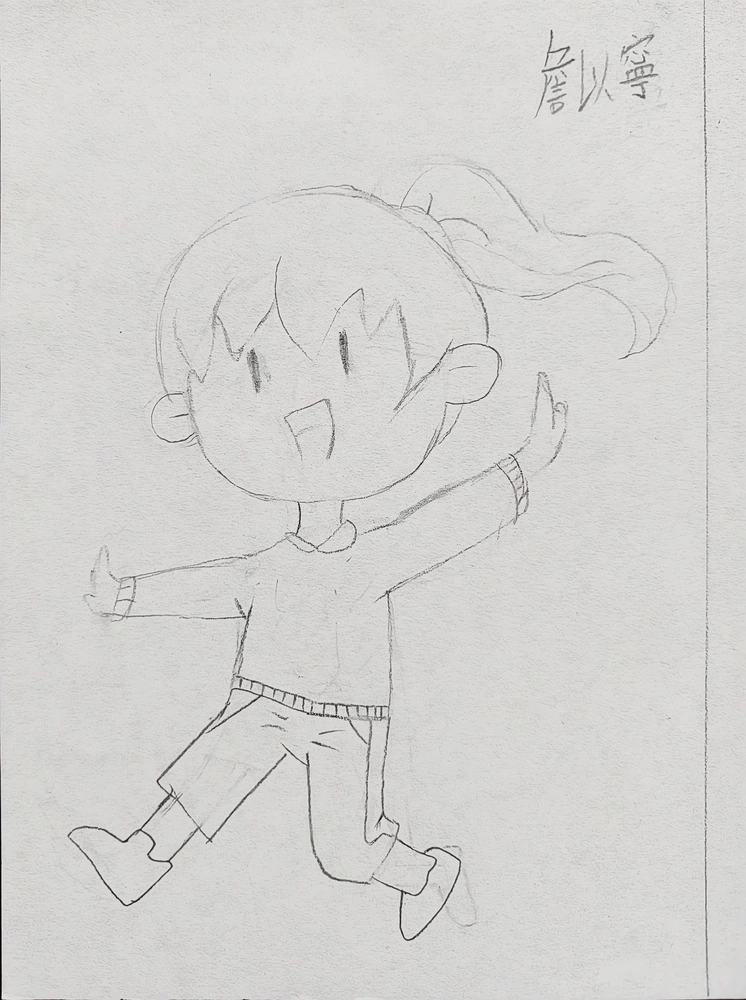
There is no stage or coloured lighting, just a girl with her arms open on a sheet of paper. A Little Dancer is a pencil drawing by Zhan Yining, known as Monica. One leg lifts forward, the other bends back and a ponytail sweeps to the side. The photographed page is still, but the pose suggests movement.
Uneven arms begin the movement
One arm extends sideways while the other opens diagonally upwards. They are not mirror images, so the shoulders and body seem to be turning rather than facing straight ahead. Even without examining the face, those directions make the pose lively. The body does not rest on a rigid central axis. Movement emerges from the relationships between its parts. There is no need for added speed lines: the unequal directions of the arms already give the viewer something active to follow.
Legs and hair carry the gesture further
The legs bend and extend in different directions, and the shoe outlines follow them. Beside the head, the ponytail makes a broad curve that contrasts with the straighter arms. Let the eye travel from the hair to the hands and down to the feet. That route shows how separate parts contribute to one gesture. We do not need to identify a named dance step. Describing what stretches, bends or curves gives a more precise account of why the figure appears to be dancing.
A few facial marks establish the mood
The relatively large face has simple dark marks for eyes and an open mouth that suggests happiness. Distinct shapes describe the fringe, and the ears remain visible. A collar, cuffs and small marks at the waist provide clothing detail without competing with the face and pose. The drawing does not distribute detail evenly everywhere. Instead, a few recognisable features give the figure expression. This allows the viewer to notice both the cheerful mood and the body’s gesture without needing elaborate shading or a busy background.
Empty paper gives the gesture room
Much of the page remains open around the figure. Pencil marks vary in darkness, the paper’s texture is visible and a handwritten name appears near the upper right. With little background, attention stays on a single moment. Viewers can imagine what happens before or after it, while the drawing itself holds only this pose. Staying with the visible lines lets us appreciate how a quiet sheet of paper can give a lively gesture enough space to be seen.
Two more questions
How can I begin by looking at the pose?
Compare the directions of the arms, then follow the ponytail and legs. Notice how their lines work together to suggest movement.
How does the drawing feel lively without colour?
The unequal arm directions, differently bent legs, sweeping ponytail and happy expression work together to suggest movement.
Explore the works in this note
Profile information was supplied by her family. These notes were prepared by the Monica portfolio editorial team from the original works, performance records and playable projects on this site, with AI-assisted writing and translation. Descriptions of existing work are distinguished from activities readers may try. The articles are editorial introductions, not first-person accounts written by Monica.
Profile and editorial notes →