 monica
CREATIVE NOTES / Art & making
Lines and Colours: Looking Before Naming
When looking at a drawing, we often ask what it represents. Lines & Colors by Zhan Yining (詹以宁), also known as Monica, invites another starting point: which line will your eyes follow, and where will they pause? Fine black paths, broader coloured curves, broken textures and scattered dots create relationships worth examining before naming a subject.
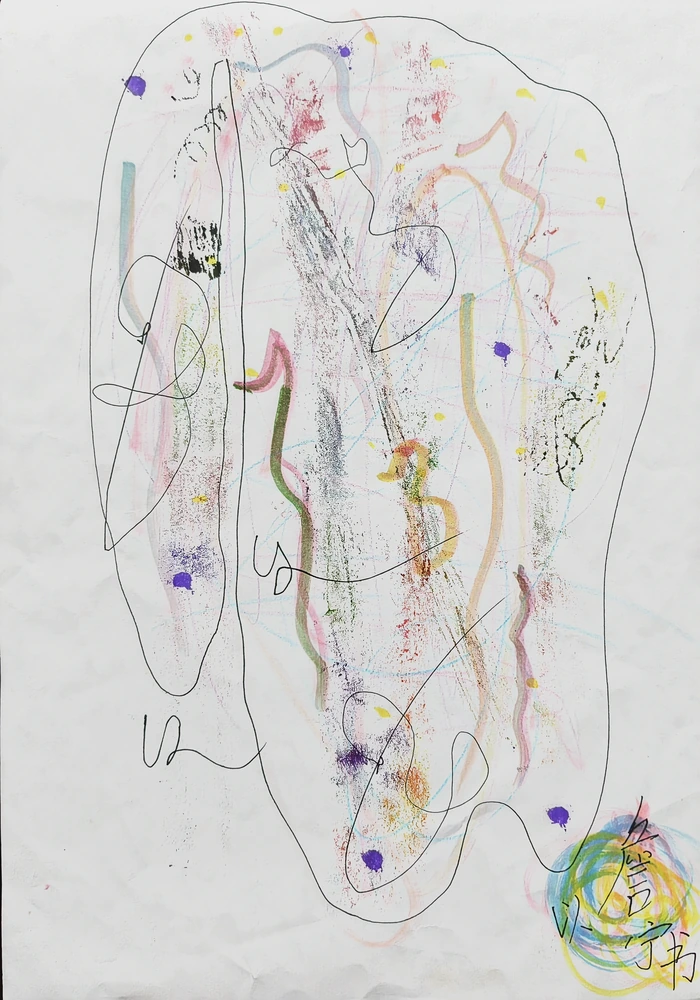
A fine line can travel a long way
Fine black lines make broad turns across the white paper. Some approach the outside edge; others return towards the centre or form small loops. They cross coloured marks without consistently following their boundaries. Trace just one section and notice that the picture does not need to fill every area to remain connected. A continuous path relates distant positions and makes the white gaps part of the journey. Its turns can be interesting in themselves, without needing to resemble a recognisable object.
Continuous paths meet broken marks
Colour appears in several forms. Broader curves sit beside broken, lightly brushed-looking textures and isolated dots. The black lines are relatively clear, while pale patches often allow white paper to interrupt them. This changes the rhythm of looking between firmer paths and looser areas. Compare whether an edge is distinct, a colour continuous, or a mark wide or narrow. Looking at neighbouring marks also reveals how they support each other: a delicate patch can make a nearby clear line stand out more readily.
Small dots provide places to pause
Yellow and purple dots appear at different heights. Some sit near lines, while others occupy pale areas on their own. Their small, concentrated shapes make them noticeable despite their limited size. After passing across a broad textured patch, your eyes may pause at a purple dot before moving towards another curve. There is no required starting point or reading order. Try tracing an imagined route above the image and notice how your attention alternates between travelling along a path and stopping at a compact mark.
Turn close looking into a line exercise
For a related exercise, start with a fine line that can turn freely across a blank page. Add two kinds of coloured marks with different widths, followed by a few small dots. Before giving the result a title, describe three visible changes: the densest area, the emptiest area and a change of direction. Another viewer may find a different route. This activity develops a vocabulary for close looking, so that describing what is present becomes more precise than attaching a quick label.
Two more questions
Must the drawing resemble something specific?
No. Length, turns, spacing and the positions of dots are already things to observe. Any associations can remain open to more than one answer.
How can a response to the drawing become more specific?
Start with a location and describe a change, such as a line turning beside a purple dot. Connecting a response to a visible detail makes it easier to share.
Explore the works in this note
Profile information was supplied by her family. These notes were prepared by the Monica portfolio editorial team from the original works, performance records and playable projects on this site, with AI-assisted writing and translation. Descriptions of existing work are distinguished from activities readers may try. The articles are editorial introductions, not first-person accounts written by Monica.
Profile and editorial notes →