 monica
CREATIVE NOTES / Art & making
The Gaps Help Draw the Hand: Clues in a Paper Cutout
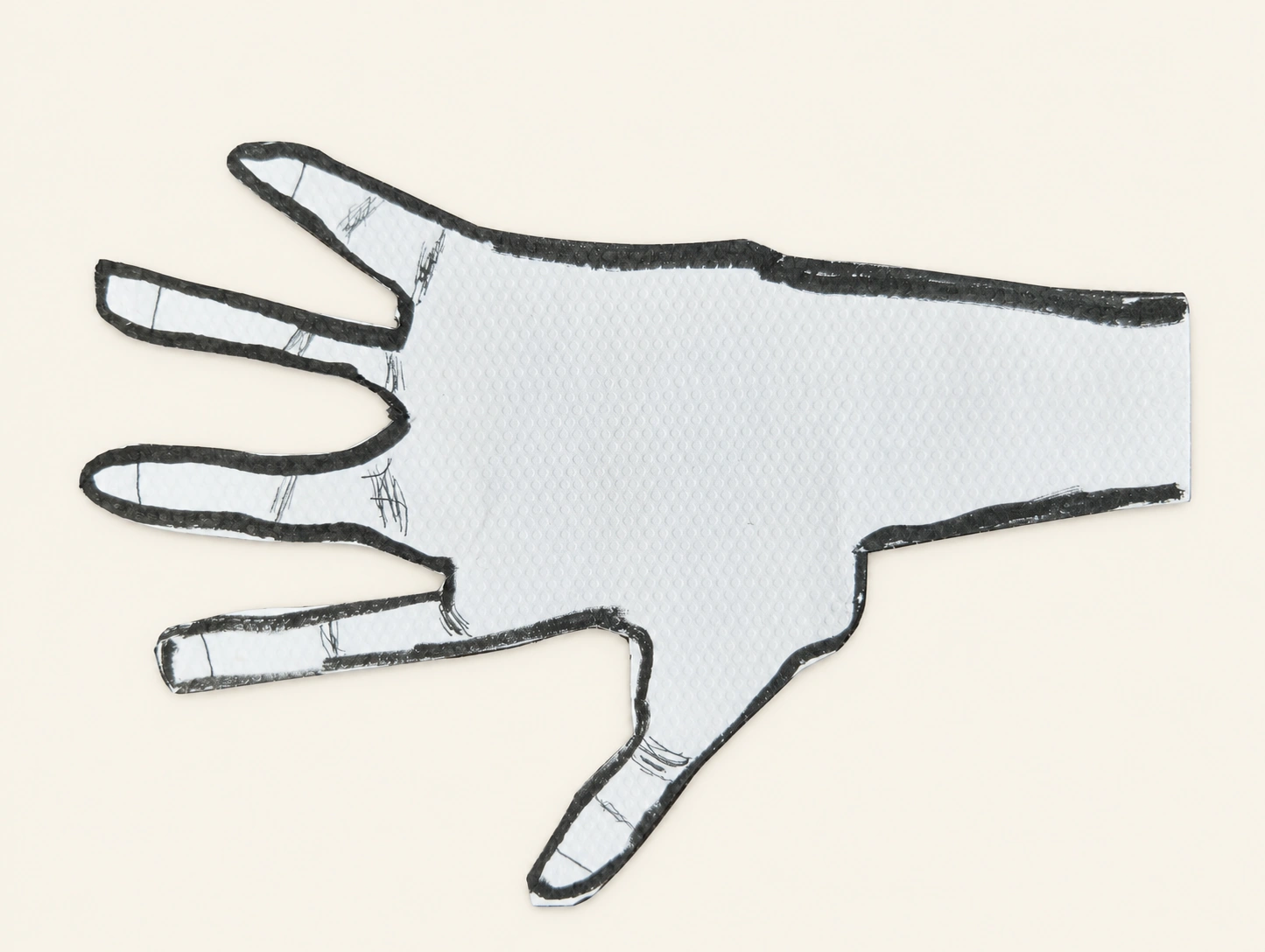
A dark line follows the fingers and wrist, with pale spaces between the fingers helping define the shape. Monica’s My Little Hand uses few colours but offers both an overall silhouette and small details. This editorial observation follows Zhan Yining’s work page and photograph without treating the cutout as evidence of actual hand size, age or which hand it represents.
Follow the boundary from the wrist
The photographed cutout lies sideways, with the wrist extending right and the fingers spreading leftwards and downwards. Follow the dark boundary through fingertips, gaps and palm edge back to the wrist. The continuous route makes a hand legible as a whole rather than as separate strips. Its orientation is a feature of the photograph; it need not be rotated or cropped into a more familiar pose to be understood.
Look at paper and the spaces without paper
The cut spaces separate neighbouring finger shapes. Follow them from the fingertips towards their bases and notice how the shapes join the palm. Look first at the paper, then at the background visible between it. The same boundary can be read from either side. These gaps are not automatically missing or unfinished pieces; they contribute visible information about the fingers’ separation.
The border and small marks do different jobs
The outer border is broad, while shorter lines and finer marks appear inside the fingers. The edge identifies where the paper hand ends; internal marks suggest local details such as joints. The silhouette is easier to read at a distance, with smaller marks emerging closer up. They need not correspond to every crease of real skin and provide no basis for conclusions about growth or anatomy.
Keep the surface details visible
The photograph retains paper texture, small variations at the edge and differences in the dark marks. These keep the object recognisable as something cut and drawn by hand rather than a standard icon. A clean display background can clarify its edge without straightening fingers, smoothing every line or removing internal marks. The existing shapes and marks are the evidence for the reader’s observation.
Separate overall and local observations
Write one sentence about how the fingers spread and another about marks near a joint. You can also trace a gap with a finger in front of the screen without touching or changing the work. This editor-suggested activity practises specific description rather than reconstructing Monica’s assignment. The page records neither a creation date nor whether her own hand was traced, so no age, measurements or making sequence is added.
Two more questions
Can the photograph measure Monica’s hand?
No. There is no scale, and the material does not confirm a full-size tracing of her own hand.
Why retain variations in the dark outline?
They are marks in the original work. Cleaning a display background does not require changing those lines or details.
Explore the works in this note
Profile information was supplied by her family. These notes were prepared by the Monica portfolio editorial team from the original works, performance records and playable projects on this site, with AI-assisted writing and translation. Descriptions of existing work are distinguished from activities readers may try. The articles are editorial introductions, not first-person accounts written by Monica.
Profile and editorial notes →