 monica
CREATIVE NOTES / Art & making
Mint-Green Origami Hearts: Similar Forms, Different Folds
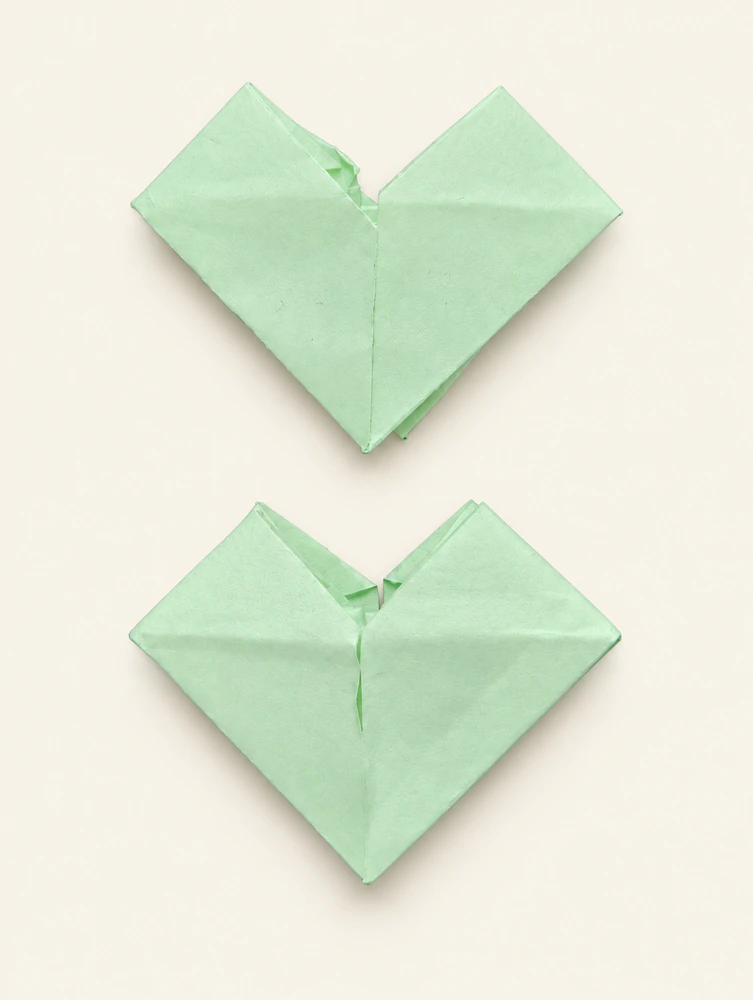
Mint-Green Origami Hearts by Zhan Yining (詹以宁), also known as Monica, shows two paper hearts in a similar colour. Both have downward points and upper notches, but their corners, creases and layers differ on closer inspection. The pair offers a useful opportunity to notice similarities first and differences second, without turning the comparison into a ranking.
A few changes of direction suggest a heart
The upper parts are made from diagonal edges and corners rather than smoothly drawn curves. A central notch separates left and right, while the lower edges meet in a point. The shapes remain easy to recognise as hearts, showing that recognition does not require every edge to match a familiar rounded icon. Follow the outer boundary before looking inward. Changes of direction carry much of the information, while the shared mint-green colour brings the folded areas together as one form.
A crease is both a line and a surface change
The central vertical creases are clear, with fainter horizontal marks and exposed layers also visible. A crease differs from a drawn line because it comes from a change in the paper’s direction. It may appear as a narrow highlight or a slight shadow. Compare interior creases with the outer contour: one remains within the form, while the other determines where it ends. This distinction helps explain the visible layering of folded paper without requiring a reconstruction of every making step.
A pair makes small differences easier to notice
The upper heart has a relatively close central seam. Near the lower heart’s notch, a more noticeable opening and small folded corners can be seen. The points and side edges also meet a little differently. These details might pass unnoticed in a single object but become clearer in a pair. Compare matching positions first, then move to another pair of corners. The hearts share an overall form while retaining their own folding traces, and their paired display makes those small differences easier to notice.
Describe differences before judging them
To try this yourself, place two simple folded objects under similar lighting and view them from the same angle. Describe three visible differences, such as notch depth, corner position or how clearly a crease appears. Then decide which detail you would like to adjust. If an edge is slightly displaced, explain what that changes instead of simply calling it a failure. This approach turns comparison into specific observation and gives a future attempt a manageable point of focus.
Two more questions
Must the two hearts be identical?
Identical results need not be a condition for appreciation. First observe the shared structure, then discuss the creases and corners visible in each object.
How can the creases in the two hearts be compared?
Find the central vertical lines first, then compare faint horizontal creases and exposed edge layers. Focus on one pair of matching positions at a time.
Explore the works in this note
Profile information was supplied by her family. These notes were prepared by the Monica portfolio editorial team from the original works, performance records and playable projects on this site, with AI-assisted writing and translation. Descriptions of existing work are distinguished from activities readers may try. The articles are editorial introductions, not first-person accounts written by Monica.
Profile and editorial notes →