 monica
CREATIVE NOTES / Art & making
From a Sheet to an Inside: Reading Monica’s Paper Box
Where do colours appear after the edges of a sheet are folded upwards? Monica’s colourful paper box brings purple walls, a blue-and-green interior and a darker lid surface into one craft. Zhan Yining’s photographed work offers a concrete way to consider an outside and an inside together. This editorial observation reads the completed form rather than reconstructing an unavailable template or tutorial.
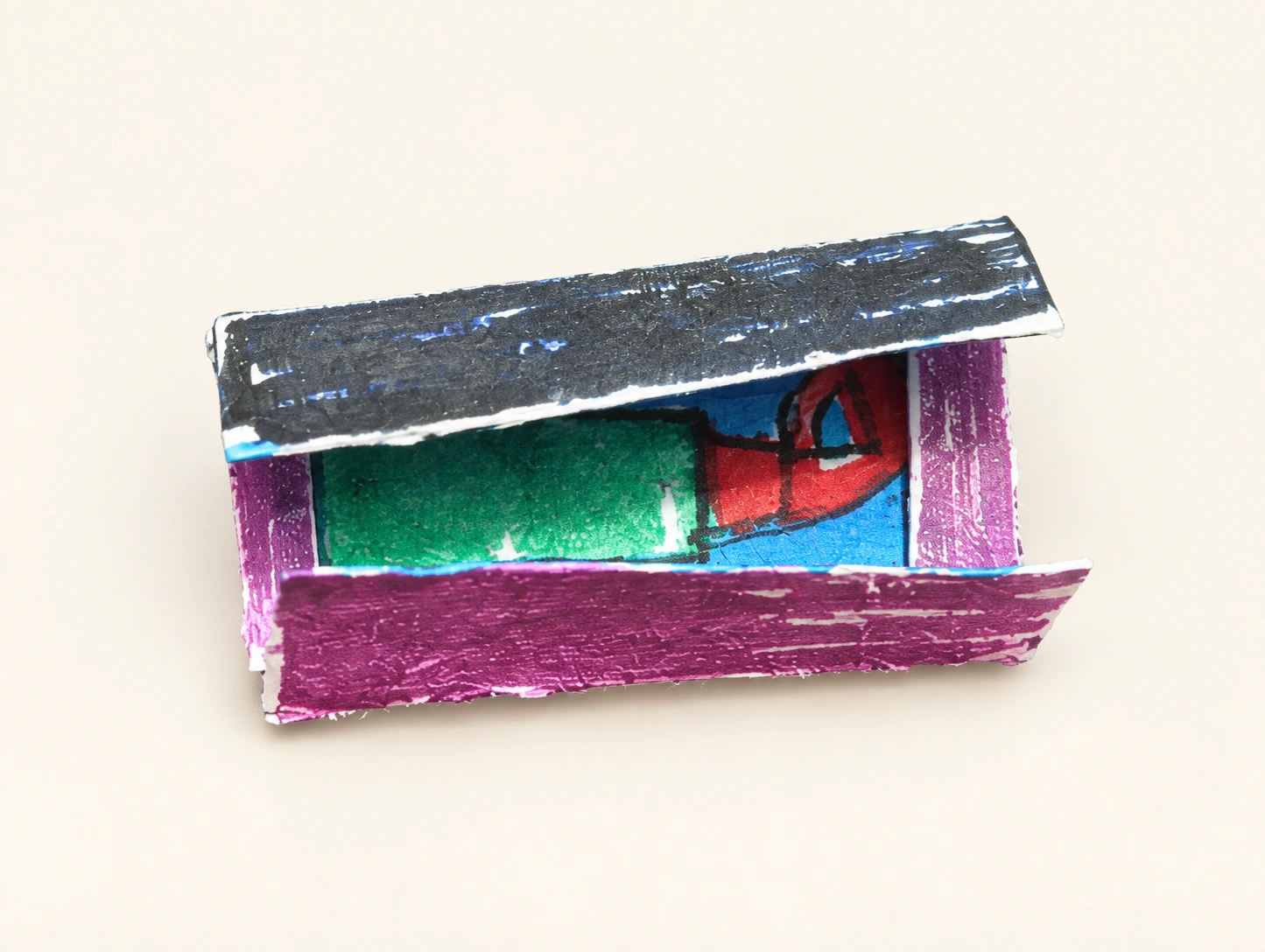
The front strip turns a surface into a wall
A long purple face rises at the front, with shorter side walls at either end. These are folded paper surfaces rather than merely a frame drawn on one plane. Trace the front upper edge towards its connections with the sides to see the enclosure. No measurements are needed to explain why the recorded object reads as a box rather than simply a coloured pattern.
Distinguish the walls from the interior
Behind the front wall, a broad green area, blue surface and part of a red motif are visible, occupying different faces from the purple sides. Colour helps distinguish positions but does not prove that each coloured region was assembled from a separate piece. Begin with which colour appears on which visible surface before asking whether the evidence establishes how it was made.
The lid reveals something by covering something
A dark rectangular lid lies diagonally across the upper part, with white paper and some blue marks visible at its edge. It covers part of the interior. The work page identifies a hinged lid, while the photograph records this particular position. That supports a description of the relationship between lid and body, not a guarantee of smooth closure, locking or repeated movement without damage.
The coloured areas retain their marks
Pale gaps and strokes with varying directions remain within the purple and dark areas, and the folded edges are not perfectly uniform. These details record a handmade paper object rather than a polished product rendering. Tidying a display background need not mean flattening every mark or redrawing the interior motif to resemble commercial packaging. A useful work record begins with fidelity.
Label three kinds of surface
Identify the front wall, interior and lid in the photograph, giving each a different observation. For documenting a paper box of your own, choose a viewpoint that reveals both the outside and inside while keeping the full lid edge. This editor-suggested activity is not attributed to Monica. No dimensions, contents or tests are recorded, so the note adds no storage capacity, load rating or specific use.
Two more questions
Is this a folding tutorial?
No. It reads the finished structure; the available material does not establish a full template and sequence.
Can its capacity be established?
No. The photograph includes neither a scale nor a capacity test.
Explore the works in this note
Profile information was supplied by her family. These notes were prepared by the Monica portfolio editorial team from the original works, performance records and playable projects on this site, with AI-assisted writing and translation. Descriptions of existing work are distinguished from activities readers may try. The articles are editorial introductions, not first-person accounts written by Monica.
Profile and editorial notes →