 monica
CREATIVE NOTES / Art & making
How Can a Small Paper Scrap Hold a Face and a Name?
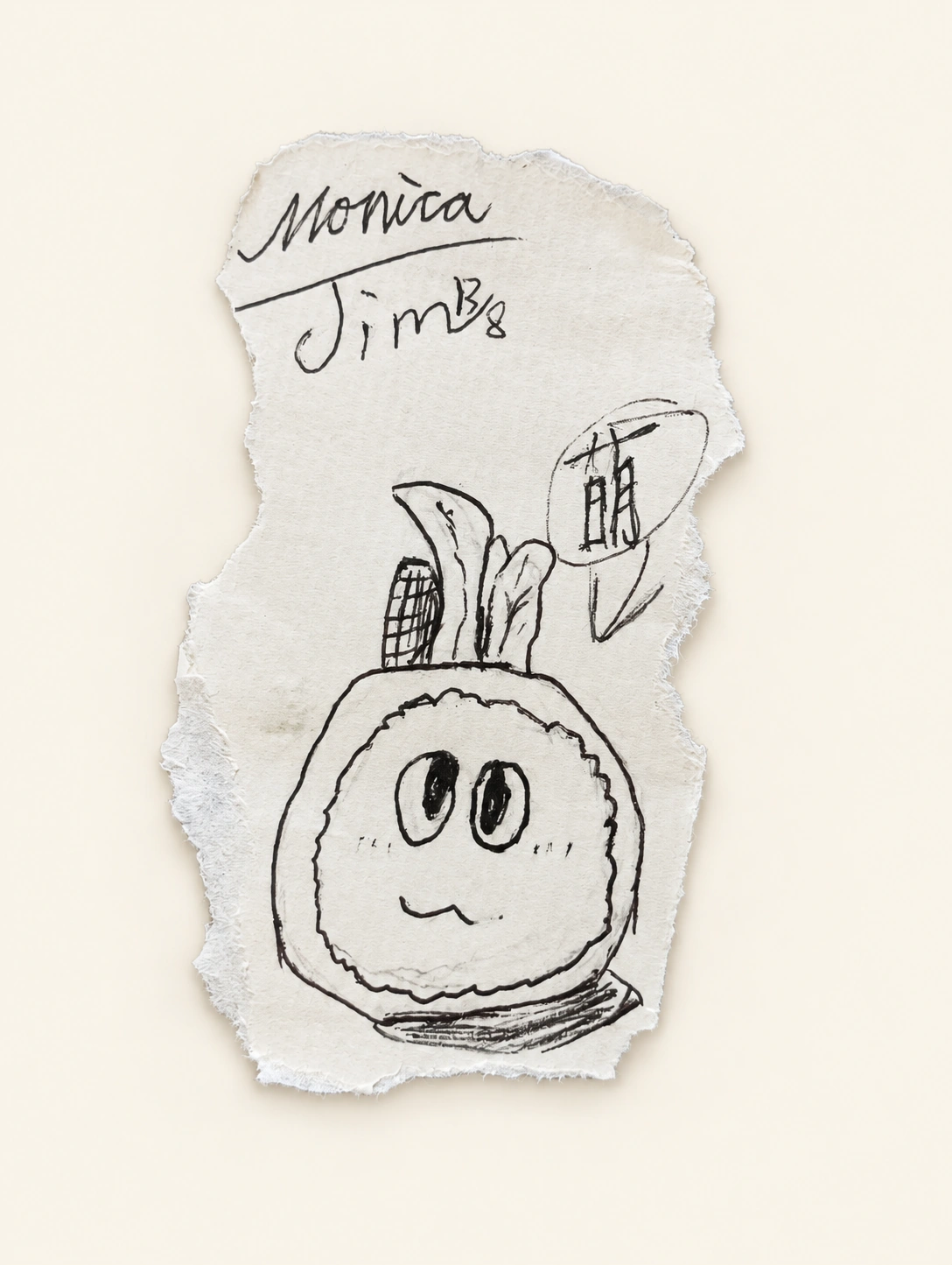
An irregular paper scrap carries Monica at the top, a large round face below and the character 萌 beside it. Hong Kong primary student Zhan Yining’s drawing uses few colours but gives the viewer several places to pause. This editorial observation reads the face, lettering and paper edge in the existing photograph without assigning unconfirmed identities to other handwritten marks.
Read the expression before naming a character
Two oval eyes contain darker marks, a small curved mouth sits below them, and short strokes appear at the sides. A few lines make a smiling face legible. Shapes extend upwards above it; you can compare their lengths and curves without deciding that they belong to a particular existing cartoon character. Describing what is visible establishes a firmer starting point than guessing a source.
Notice more than one boundary around the face
Around the face, an undulating inner line, a smoother outer contour and short overlapping marks near the bottom remain visible. Moving outwards from the eyes reveals different layers of drawing. These distinguish central expression from surrounding shapes. Several lines in one place do not by themselves prove a mistake, revision or making sequence. The photograph records surviving marks rather than the process that produced them.
Lettering and a line organise separate areas
Monica’s handwritten name occupies the top, with a line separating that area from marks below; 萌 appears near the upper right of the face with surrounding strokes. Lettering is readable content but also has size, position and shape. Follow the name towards the face and notice the route across the paper. Other unconfirmed writing can remain intact without being converted into an identity or narrative.
An irregular edge gives the drawing its own space
The paper is not a regular rectangle, and its uneven edge and small fibres remain visible in the photograph. The face and words sit within that particular boundary, with some pale surface left unmarked. A clean display background can make it clearer without trimming it into a standard card or smoothing its edge. The actual paper shape contributes alongside the drawn lines to the recorded work.
Find a clue to read and a shape to follow
Choose one piece of lettering you can confidently read and one contour whose position you can describe. Separating the two observations gives more detail than a single verdict such as “cute”. This is an editor-suggested viewing exercise, not Monica’s classroom record. The page supplies no creation date, and paper size does not establish age or time spent making it. AI-assisted editorial writing does not replace the original handwritten evidence.
Two more questions
Is a particular cartoon character confirmed?
The available description does not confirm a character source; this note describes visible expression and lines.
Why not make the edge a neat rectangle?
The irregular edge belongs to the original work and should remain in its presentation.
Explore the works in this note
Profile information was supplied by her family. These notes were prepared by the Monica portfolio editorial team from the original works, performance records and playable projects on this site, with AI-assisted writing and translation. Descriptions of existing work are distinguished from activities readers may try. The articles are editorial introductions, not first-person accounts written by Monica.
Profile and editorial notes →