 monica
CREATIVE NOTES / Art & making
Paper Doll in a Red Dress: A Figure Built from Edges
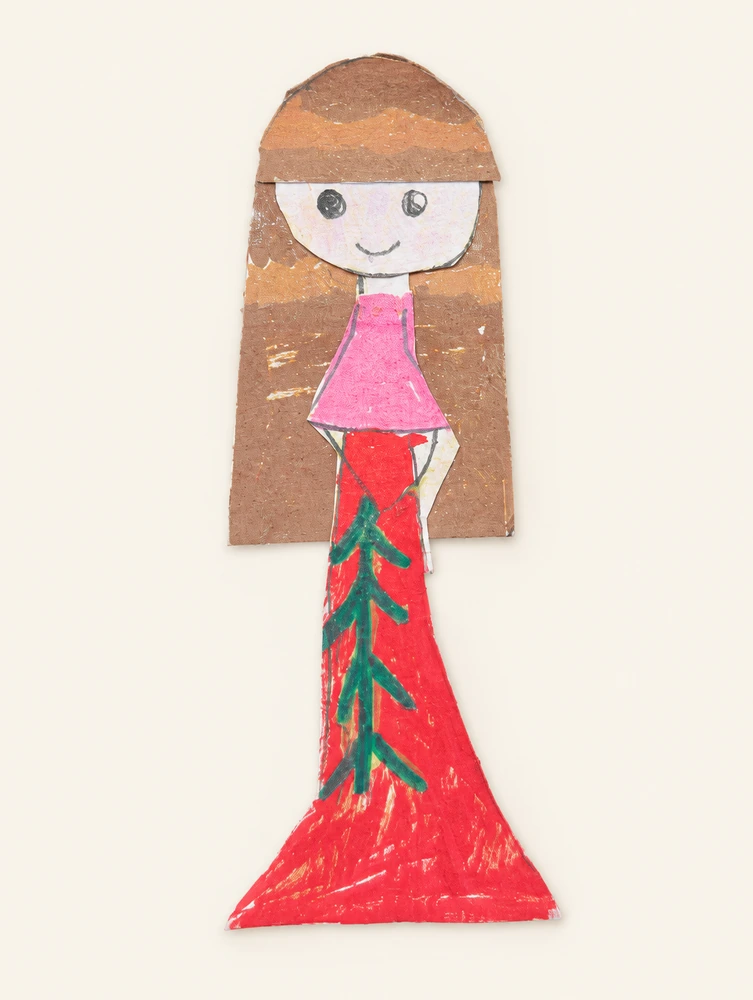
Paper Doll in a Red Dress by Zhan Yining (詹以宁), also known as Monica, presents one figure: long brown hair surrounds a smiling face above a pink top and a red skirt carrying a green leafy motif. Drawing supplies the colour, while cutting gives that colour physical edges. Their combination rewards a close look from head to hem.
Begin with the outer silhouette
A curved top leads into long sections of hair, while the skirt widens near the bottom. The silhouette shifts between narrower and wider areas. Even before examining the face or decoration, these changes help identify a head, body and long dress. The cut edges are not perfectly straight; small irregularities remain visible. They preserve the character of a handmade object and show that the outer boundary is not merely a border around the work. It actively contributes to the figure’s appearance.
Layers create relationships beyond colour
At the meeting of face and hair, and along the lower edge of the pink top, overlapping edges suggest front-and-back relationships. Two simply drawn eyes and a curved mouth stand out against the broad brown hair. Look twice: first for lines made by drawing, then for the actual boundaries of the paper. Sometimes the two meet; elsewhere they remain distinct. This distinction gives the paper doll a kind of layering different from a figure drawn directly onto one uncut sheet.
A green motif leads the eye down the skirt
A green motif runs down from near the waist, its stem and branching leaf shapes following the length of the red skirt. That direction gives the lower half more to read than a broad patch of red. Near the wider hem, visible colouring marks and lighter gaps remain. From a distance, the work separates into red, green, brown and pink areas. Up close, variations within those areas become clearer. Each viewing distance therefore reveals information that the other can easily overlook.
Build a paper figure from a few shapes
For a related activity, draw a figure’s outline and consider just its hair, clothing and one decorative motif. Aim to make the figure readable with a small number of parts. Before cutting, check narrow areas that might tear, and ask an adult for help with scissors if needed. Experiment with overlapping pieces: how much of the face is covered, and is the clothing still recognisable? Choose your own decoration rather than copying the leafy motif on this skirt.
Two more questions
Should viewers start with the outline or the skirt pattern?
Start with the whole figure from farther away, then move closer to the green motif. This makes it easier to see how the decoration relates to the long skirt.
How does it differ from drawing a person?
Alongside drawn lines and colours, the doll has physically cut edges and overlapping layers. Both structures contribute to how the figure is read.
Explore the works in this note
Profile information was supplied by her family. These notes were prepared by the Monica portfolio editorial team from the original works, performance records and playable projects on this site, with AI-assisted writing and translation. Descriptions of existing work are distinguished from activities readers may try. The articles are editorial introductions, not first-person accounts written by Monica.
Profile and editorial notes →