 monica
CREATIVE NOTES / Art & making
How Can Paper Strips Fan Out in One Work and Wind through Another?
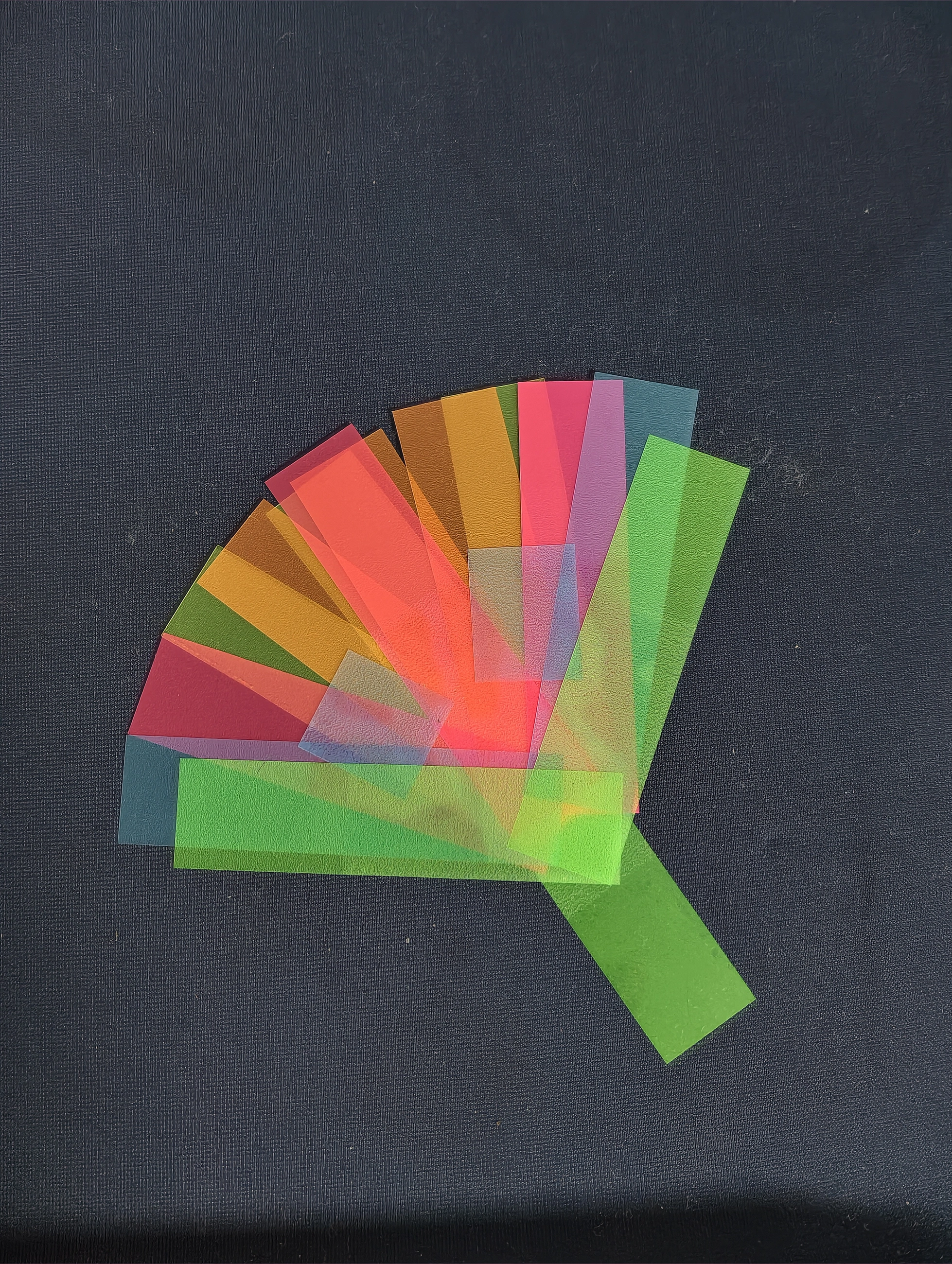
A paper strip can lead the eye in more than one direction. In Hong Kong primary student Zhan Yining’s collection, Monica’s colourful strip collage opens out across a surface, while her yellow-and-purple paper snake follows a winding route. Reading the two photographed works together raises a practical question: what small unit repeats, and how does its direction change? This is an editorial comparison of the finished works, rather than a reconstruction of her making process.
Find the unit before naming the whole
Start with one straight-edged strip in the collage and trace where it covers another strip or disappears beneath one. In the snake, follow a yellow fold into its neighbouring purple face. The collage organises a surface through overlapping strips; the snake builds a continuous band from repeated folded sections. There is no need to decide that the collage represents a bouquet, or to look for a snake’s eyes, before describing these visible relationships.
Collage: a recurring shape with changing directions
The collage’s strips are not all parallel. Several spread in different directions towards the upper part, horizontal strips cross the lower arrangement, and a green strip extends towards the lower right. A recurring long shape can therefore send the eye along different routes. Trace three directions with a finger in front of the screen. You need neither touch the original nor measure exact angles to see that similar shapes need not point the same way.
Snake: repeating faces along a changing route
The snake photograph shows alternating yellow and purple folded faces along a curled band. Up close, creases and paper layers are visible; from farther away, you can follow the overall route. Alternating colour describes a local rhythm, while the route describes the arrangement of the whole. These are separate observations. A still image does not establish how the object stretches or moves, or whether every folded section has exactly the same length.
The spaces also help organise the view
A broad dark background surrounds the collage, with denser colour where strips overlap. In the snake photograph, the pale background remains visible inside and outside the loops. Look first at the paper, then at the spaces around it. The exercise is not a judgement about which work is better. It distinguishes two arrangements: overlapping strips that spread across a surface, and a continuous band whose route defines spaces.
Try changing direction while keeping the pieces
Using safely prepared strips of your own, arrange the same pieces in parallel, then spreading from one area, then following a turning route. Compare which arrangement most strongly invites your eye to follow it. Photograph the three layouts and add one observation to each. This is an editor-suggested activity, not an activity attributed to Monica. It turns a question raised by her two works into a comparison you can make yourself.
Two more questions
Do both works use the same making method?
Their pages identify paper-strip collage and two-colour paper folding. The comparison concerns repetition and direction, rather than treating them as one craft technique.
Can the photographs establish which work came first?
No. Neither page records a creation date, so this note does not assign an order or developmental stage.
Explore the works in this note
Profile information was supplied by her family. These notes were prepared by the Monica portfolio editorial team from the original works, performance records and playable projects on this site, with AI-assisted writing and translation. Descriptions of existing work are distinguished from activities readers may try. The articles are editorial introductions, not first-person accounts written by Monica.
Profile and editorial notes →