 monica
CREATIVE NOTES / Art & making
Dots on a Curved Surface: Three Views of Monica’s Pumpkin
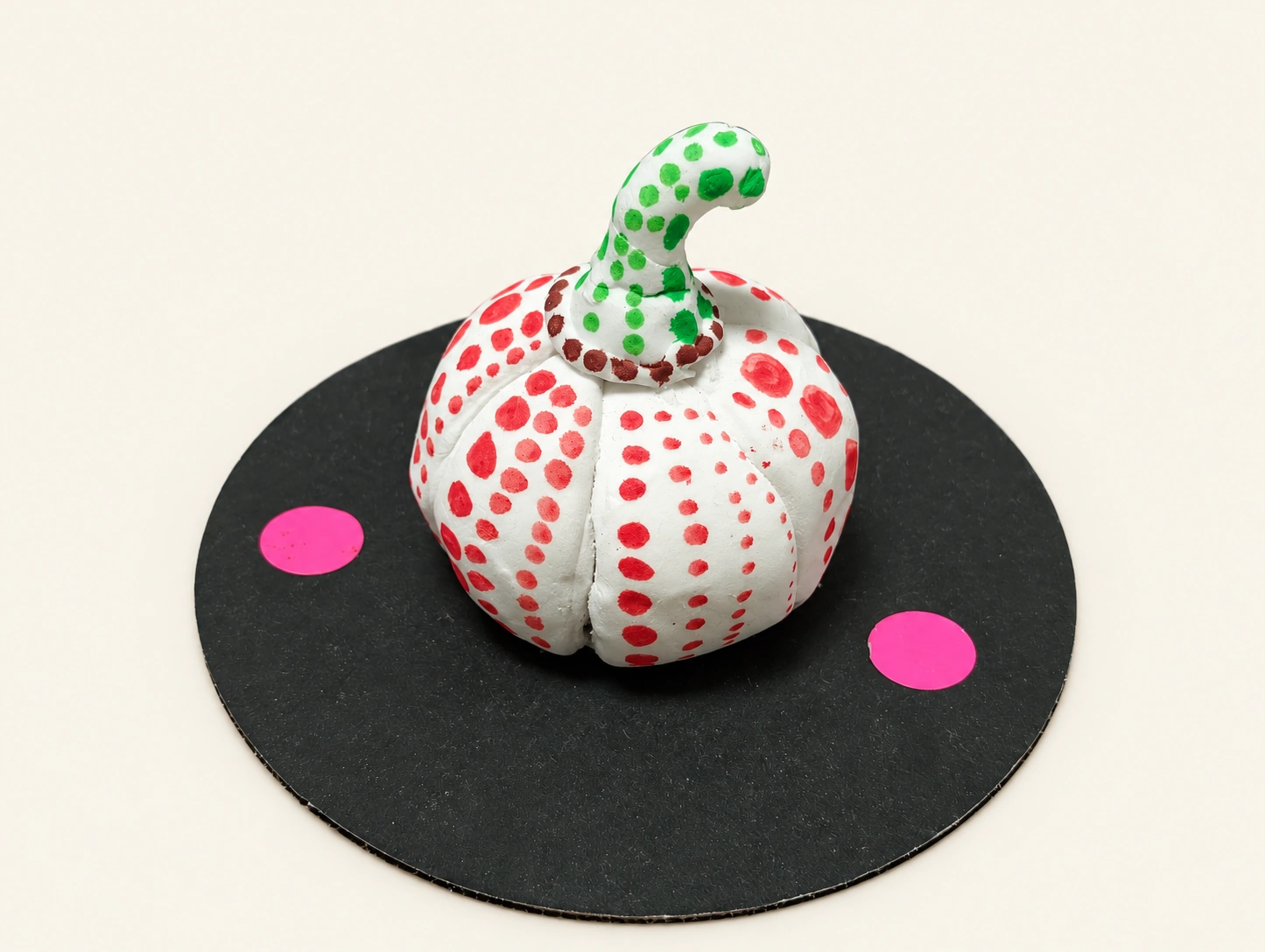
What changes when dots travel around a pumpkin rather than across a flat sheet? Hong Kong primary student Zhan Yining’s dotted pumpkin combines a white body, red dots, a green-dotted stalk and a black circular base. Monica’s work page preserves three photographs. This editorial observation follows side and top views to examine how a surface pattern interacts with a three-dimensional form.
Notice the marks and the spaces between them
The red marks vary in size, with white surface visible between them. Near the visible edge, they turn away with the curved body instead of facing the viewer as directly as those in front. Begin with a small patch and compare larger marks, smaller marks and gaps. A single side photograph does not reveal the entire back, so it cannot establish the total number of dots on the object.
Separate the grooves from the painted pattern
The side view shows rounded lobes separated by downward-running grooves. Red marks occupy this changing surface, so form and pattern remain visible together. Follow a groove first, then look across to nearby dots. One cue describes the object’s volume; the other describes its surface arrangement. The photograph does not establish the internal construction or the exact material and tools used to make it.
From above, the stalk changes its visual role
The top photograph reveals how the lobes surround the stalk. Its upward bend in the side view becomes a shape crossing near the centre. Green dots remain on the stalk, and brown marks appear around the join. The viewpoint changes, rather than the work suddenly acquiring new colours. Locate the same stalk in both views before comparing the surrounding body; that gives the photographs a clear relationship.
The base introduces a larger circle
The black circular base carries pink and orange-red circles at a different scale from the smaller painted marks on the body. From above, its overall boundary becomes clearer; from the side, its edge is visible. It establishes the display area and invites a comparison between a circular support and a dotted pattern. Similar outlines alone do not prove that these elements share a material, making method or size.
Give two photographs different questions
When recording a three-dimensional craft, try a side photograph for height and outline and a top photograph for surface arrangement. Give each a sentence explaining what it reveals. This is an editor-suggested documentation method, not Monica’s account of making the work. Her album provides viewing evidence, without establishing a creation date, competition, exhibition or lesson associated with a particular artist.
Two more questions
Do the three photographs show three pumpkins?
The page identifies one work documented in three photographs: two side views and one top view.
Can the images establish a particular artist’s influence?
No. Dots alone do not establish a creative source; this note describes visible form and pattern.
Explore the works in this note
Profile information was supplied by her family. These notes were prepared by the Monica portfolio editorial team from the original works, performance records and playable projects on this site, with AI-assisted writing and translation. Descriptions of existing work are distinguished from activities readers may try. The articles are editorial introductions, not first-person accounts written by Monica.
Profile and editorial notes →