 monica
CREATIVE NOTES / Art & making
Colourful Paper-Strip Collage: What Happens at an Overlap
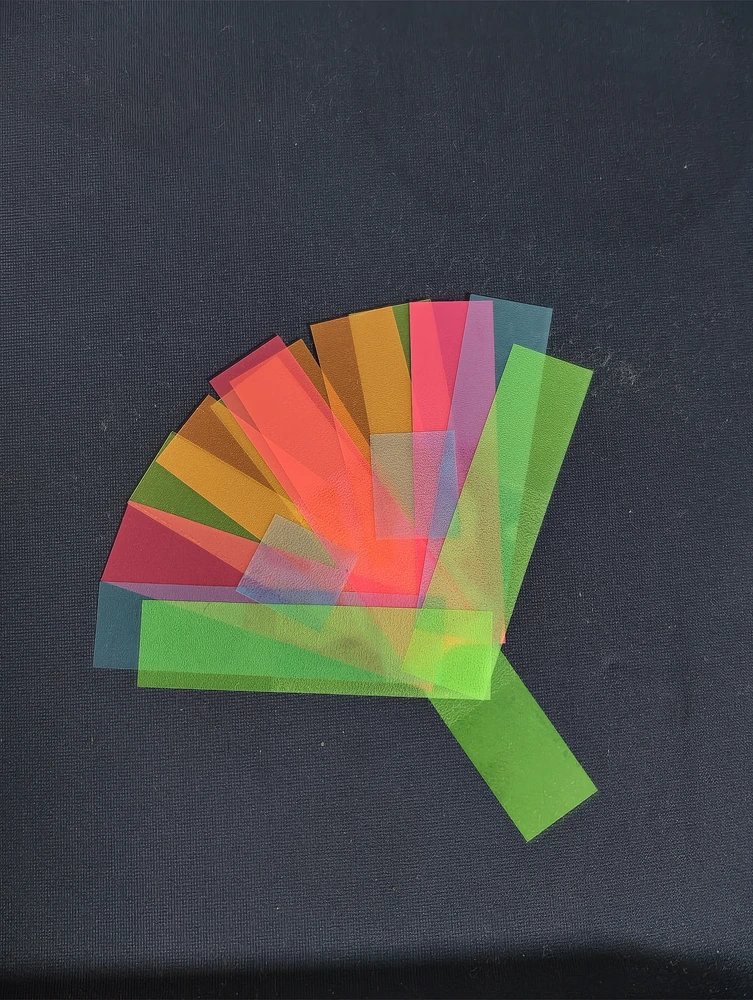
In Colourful Paper-Strip Collage, Zhan Yining (詹以宁), also known as Monica, arranges orange, pink, green and blue strips against a dark surface. Direction, overlap and the space around the cluster supply the main information. A useful starting question is simple: what changes where the edge of one strip crosses another?
Direction is noticed before a total is counted
The strips are not all parallel. Several spread out at different angles near the top, more horizontal strips cross the lower portion, and a longer green section extends towards the lower right. We may sense these directions before counting the pieces. Follow their long edges to distinguish those that run together from those that turn away. Simple rectangular shapes therefore do more than repeat: in combination, they create routes that can be followed through the cluster.
Seeing lower layers creates new colour areas
At some overlaps, lower colours or edges remain visible, producing smaller areas with different apparent tones. A strip does not look identical along its whole length because what lies beneath it changes. Choose one piece and compare exposed areas with places where one or several layers meet. Then slowly follow one edge through the arrangement. The boundaries of the small colour areas emerge where separate strips cross, allowing a visually complex patch to be understood through a few simple relationships between long edges.
Dark surrounding space defines the cluster
The strips gather around the middle and lower part of the image, leaving a large area of dark ground around them. This surrounding space makes outer diagonals, corners and the projecting green strip easier to see. A tightly cropped view directs attention to changes within the overlaps. Returning to the whole image reveals where the cluster sits and how far its parts extend. Moving between these two scales is a practical way to study both the colours and the arrangement.
Move one strip at a time and compare
For your own experiment, arrange strips on both lighter and darker backgrounds without fixing them down. Move only one strip at a time. Compare parallel, crossing and spreading directions, then inspect the space left around them. If your material lets lower layers show through, study the overlaps. If it does not, compare the edges created by covering another strip instead. Both outcomes are useful. The purpose is to connect each small movement with a visible change in the composition.
Two more questions
Should viewers begin with the whole or an overlap?
Begin with the direction of the whole cluster, then choose an overlap and examine its colours. Moving between the two connects local changes with the overall arrangement.
Must a related exercise use translucent paper?
No. Different levels of translucency change the overlap effect. Opaque paper can still be used to compare direction, covering, edges and surrounding space.
Explore the works in this note
Profile information was supplied by her family. These notes were prepared by the Monica portfolio editorial team from the original works, performance records and playable projects on this site, with AI-assisted writing and translation. Descriptions of existing work are distinguished from activities readers may try. The articles are editorial introductions, not first-person accounts written by Monica.
Profile and editorial notes →