 monica
CREATIVE NOTES / Art & making
How Can Pencil Marks Make a Hat Look Soft?
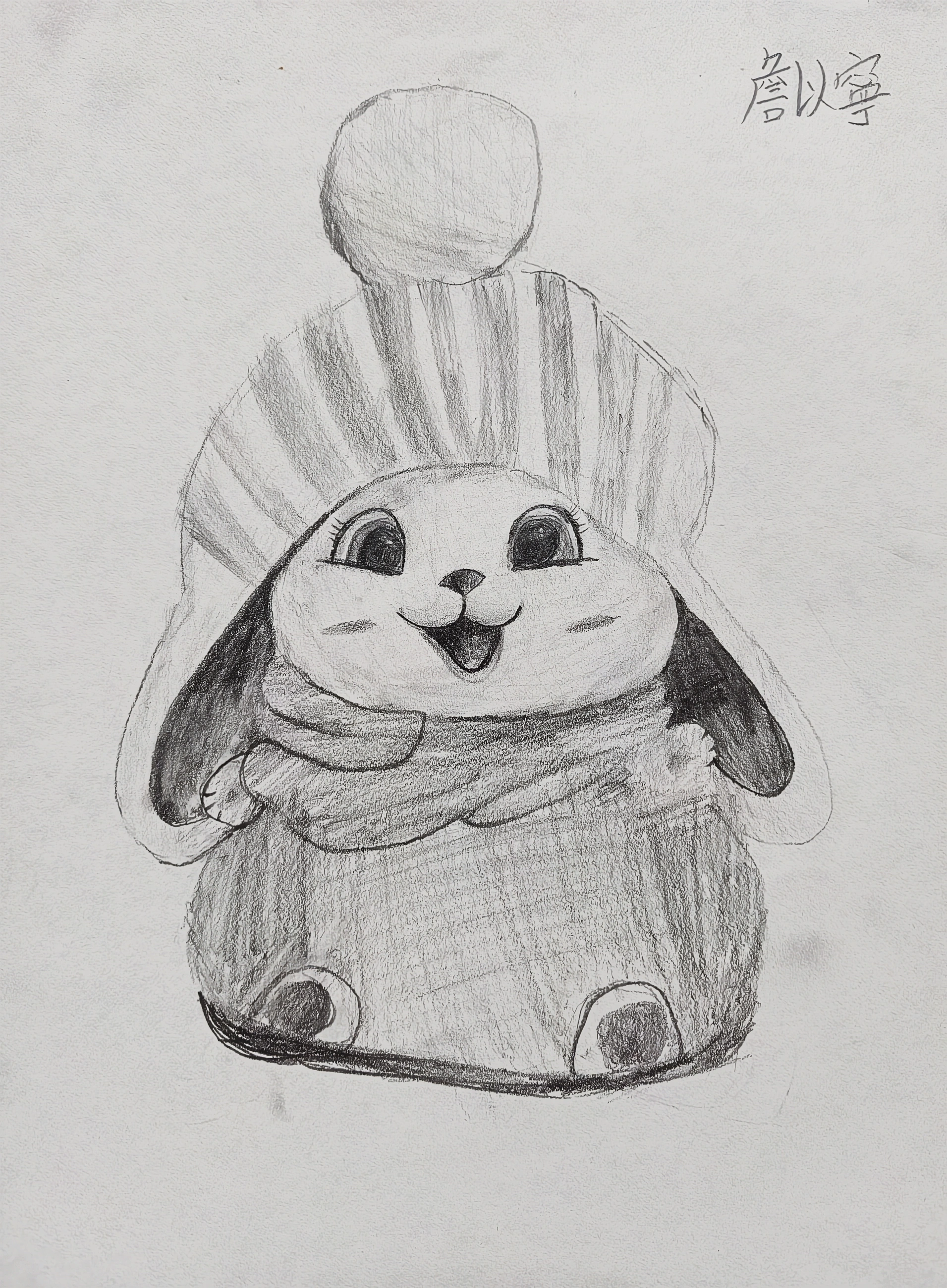
There is no coloured yarn or actual fur on the page, yet the hat looks soft. A Rabbit in a Woolly Hat is a pencil drawing by Zhan Yining, also known as Monica. A large hat, scarf and rounded body carry different marks around a pale face. This editorial reading of the photograph compares their direction, spacing and edges to explore how a single medium can suggest different textures.
The hat’s bands change direction across the shape
Long grey bands run through the hat, separated by lighter spaces. Near the centre they rise upwards; towards the sides they spread diagonally. They do not form a row of evenly spaced, parallel lines. Trace one band from bottom to top, then look at its lighter neighbour. Alternating values suggest ridges across the broad shape, while the broken pencil marks keep the shaded areas from looking like flat, solid strips.
At the scarf, the marks turn a corner
Below the face, many scarf marks travel sideways or curve around its folds. Their direction contrasts with the long bands above. On the left, a rounded section overlaps another shaded area, with a relatively clear boundary between them. Find that edge before following the marks on either side. The scarf becomes easier to separate into parts. Direction, as well as the outline, helps distinguish one area of clothing from another.
Dark inner ears give the pale face room to stand out
Both hanging ears have dark centres and much lighter outer margins. Dark eyes, nose and mouth sit within the lightly marked face. The cheeks offer a pause between the busier hat and scarf. From farther away, the ears and features may register before individual clothing marks. Looking closer brings those smaller textures forward. The contrast gives the drawing useful differences in emphasis, rather than asking every area to attract equal attention.
The pompom and body need not share one pattern
The round pompom is lighter through its centre and darker towards the left and lower edge. It does not repeat the hat’s clearly separated bands. Around the body, shorter, denser marks gather at the sides, leaving a lighter middle. Compare these areas: softness need not depend on one repeated pattern. Broken marks can contribute, as can changes of value across a rounded shape. We can read a texture without identifying every mark as a separate fibre.
A reader exercise: compare three small texture samples
Draw three boxes on separate paper. Fill one with upright marks of similar length, another with curves following a shared direction, and the third with scattered short strokes. Leave some paper visible in each. Compare their associations, then make part of one sample denser. Does it suggest a different surface, or simply become darker? Try a favourite pattern inside your own hat outline, checking from farther away whether its overall shape remains clear.
Two more questions
Are texture and shading the same thing?
They can work together, but you can examine them separately. Shading concerns lighter and darker areas; texture also involves direction, length and spacing. Here, both hat and scarf contain dark grey, yet their marks follow different paths.
Must every part be filled to make the hat look fluffy?
Start by leaving lighter gaps and comparing their spacing. The pale bands and pompom centre contribute to the form here. In your own drawing, add marks to just one small area and compare it with the open space beside it.
Explore the works in this note
Profile information was supplied by her family. These notes were prepared by the Monica portfolio editorial team from the original works, performance records and playable projects on this site, with AI-assisted writing and translation. Descriptions of existing work are distinguished from activities readers may try. The articles are editorial introductions, not first-person accounts written by Monica.
Profile and editorial notes →