 monica
CREATIVE NOTES / Art & making
A Yellow Bookmark: Making Room for a Face and a Name
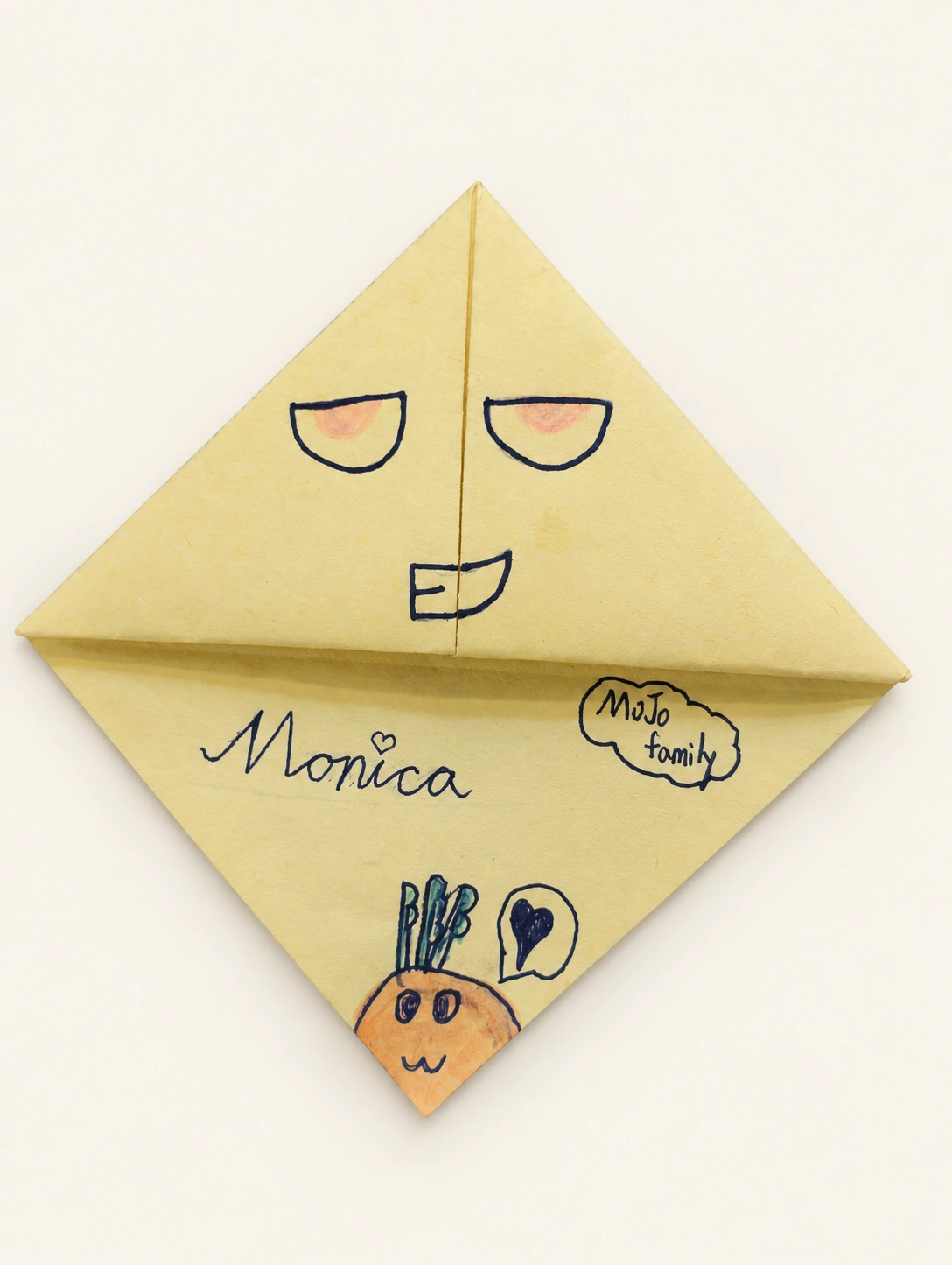
How much can fit on a yellow bookmark? This folded-paper work by Zhan Yining, also known as Monica, carries a large face, handwritten words, and a smaller face with a heart near the bottom. They occupy different parts of the paper. This editorial reading of the photograph looks at how folded areas, lettering and open space help us find our way around a small surface.
A folded edge separates two parts of the page
A horizontal folded edge casts a shadow in the photograph. The large face sits above it; Monica and MoJo family appear below. Ignore the drawings briefly and follow that edge: the paper’s structure already provides separate areas for the content. One part points upwards, while the lower area narrows towards the bottom corner. The layout works within those shapes, giving us more to notice than a flat rectangle filled with decoration.
Drawn lines meet the paper’s own edges
A vertical seam divides the upper area. Two bowl-shaped eyes sit on either side, while the small mouth crosses the seam. Both the dark pen marks and the seam are visible lines, but they have different sources: one belongs to the drawing, the other to where the paper meets. Follow each in turn. Noticing where they cross makes the face part of a folded surface, rather than a drawing floating independently of its material.
Lettering can have its own scale and pauses
Monica spreads across the lower area in large, flowing handwriting, with a small heart above it. To the right, MoJo family occupies two lines inside a cloud-shaped outline. Different arrangements help separate the two pieces of lettering: one stretches across the paper, while the other forms a compact group. Compare the space around each, including its distance from the paper’s edge. Crowding the groups together would change how easily their individual shapes could be read.
A few colour accents sit against the yellow
Yellow remains the main surface colour, with dark outlines defining the face and words. Pink inside the eyes, orange in the lower face and a few green strokes above it occupy smaller areas. A speech-bubble shape containing a heart adds another detail near the bottom. Look first at the large face and lettering, then enlarge the image for these smaller marks. The difference in scale gives the same bookmark something to offer at two viewing distances.
A reader exercise: place the parts before adding detail
On a diamond-shaped outline, draw a horizontal line to stand for a folded edge. Use three simple boxes to place a face, a name and a small motif. Before colouring, move the name once and compare the layouts. Add a few colours only after deciding where the parts belong. This suggested layout exercise does not reconstruct Monica’s folding process. Choose your own words and imagery, and leave some open paper between busy areas.
Two more questions
Does this photograph show how the bookmark grips a page?
It shows the decorated front, without a demonstration in a book. Use it to study layout. For a working bookmark, start with a folding method you know, then plan decoration on the blank folded piece.
Does a small space always need tiny lettering?
Not necessarily. Shorten the wording or use fewer motifs before shrinking every letter. Give the name enough room, then view the sketch from farther away to check whether it remains readable.
Explore the works in this note
Profile information was supplied by her family. These notes were prepared by the Monica portfolio editorial team from the original works, performance records and playable projects on this site, with AI-assisted writing and translation. Descriptions of existing work are distinguished from activities readers may try. The articles are editorial introductions, not first-person accounts written by Monica.
Profile and editorial notes →