Two concurrent fairs, different perspectives
HKTDC's 13 October announcement describes the concurrent fairs and a scope spanning consumer electronics, electronic components and advanced manufacturing technologies. The physical events run on 13–16 October.
Product teams can begin with an end-use application, then explore the components and engineering questions behind it. That does not establish that every product company accepts contract manufacturing, or that a component supplier can deliver a complete system. Capabilities and cooperation scope need separate discussion.
Identify the kind of partner you need
| Need | Relevant conversation | Clarify first |
|---|---|---|
| Purchase an existing product | Brand, product team or distribution partner | Users, market, application and service requirements |
| Source a component | Supplier for that component category | Intended use, interface, operating conditions and document version |
| Customise or co-develop | Engineering or manufacturing partner accepting that work | Existing design, unresolved problem and expected deliverable |
| Explore industry or capital connections | Industry or venture partner familiar with the setting | Company stage, current problem and intended cooperation |
Different organisations may contribute to one project. They should not be assumed to undertake every role. Identifying the task first makes a conversation easier to assess.
Prepare a one-page requirement, not a list of buzzwords
An overseas team can explain the intended user, operating setting, current development stage and one area where help is needed. An image or simple process diagram can assist, provided that proposed, developing and verified elements are clearly distinguished.
Seeking a sensing component compatible with an existing interface is different from seeking responsibility for complete product development. These are communication examples, not capabilities attributed to a particular exhibitor.
Define the work behind a sample discussion
As a discussion moves towards a sample or development task, distinguish three things: who supplies the inputs, what the partner will produce and how the parties will confirm that this stage is complete. Display samples, development samples and deliverable products should also be described according to their actual status.
Begin with a bounded piece of work rather than assuming that volume manufacturing and international support are already resolved. The scope of quotations, design files, test information and subsequent support should be agreed before formal cooperation. Intellectual-property, contractual and market-access questions require appropriate professional review.
Connect a Hong Kong market conversation with engineering
Hong Kong's fair provides a concentrated setting for international market discussions. Research, supply-chain and industrial environments in Shenzhen and the Greater Bay Area offer potential areas for subsequent engineering coordination. The value lies in carrying a market question into product work, not treating a location as a capability guarantee.
For an overseas AI-hardware team, a useful next step could be a requirements meeting followed by introductions to the relevant engineering, component or industry partners. Jimhang welcomes discussions about clarifying needs and making introductions, without guaranteeing an unverified supplier's quality or delivery.
Understand the region through specific projects
Jimhang's showcase covers sports robots, garden equipment, smart hydrofoils, local AI, sensing and industry software. These address different users and engineering problems. They should not be presented as following one identical international-market route.
Overseas industry and capital partners can begin with a familiar application, then explore the resources a team actually needs. Procurement, co-development and investment discussions each require their own next step; sharing a trade-fair setting does not make them equivalent.
Explore the ten-project booth guide or meet Jimhang at J02. The founder roadshow on 15 October, 15:00–16:30 Hong Kong time, offers another opportunity to meet teams. Contact Jimhang Capital for engineering and industry introductions, and use the fair follow-up guide to organise the next discussion.
Concurrent-fair details and exhibition scope come from HKTDC's announcement. Partner categories, examples and suggested work arrangements are editorial analysis, not supplier endorsements, technical certification or investment advice.
Hong Kong Electronics Fair and Founder Roadshow Invitation
- Exhibition
- 13–16 October 2026 · Hong Kong Electronics Fair (Autumn Edition)
- Founder roadshow
- Thursday, 15 October 2026 · 15:00–16:30 Hong Kong time
- Roadshow venue
- INNOVATIONHub, Startup Zone, Convention Hall, Old Wing 1/F, Hong Kong Convention and Exhibition Centre, Wan Chai
Presented by Jimhang Academy. The working languages are Chinese and English. The final running order and arrangements are subject to the on-site programme. The invitation poster includes the guest-registration QR code; eligibility and exhibition admission remain subject to organiser confirmation.
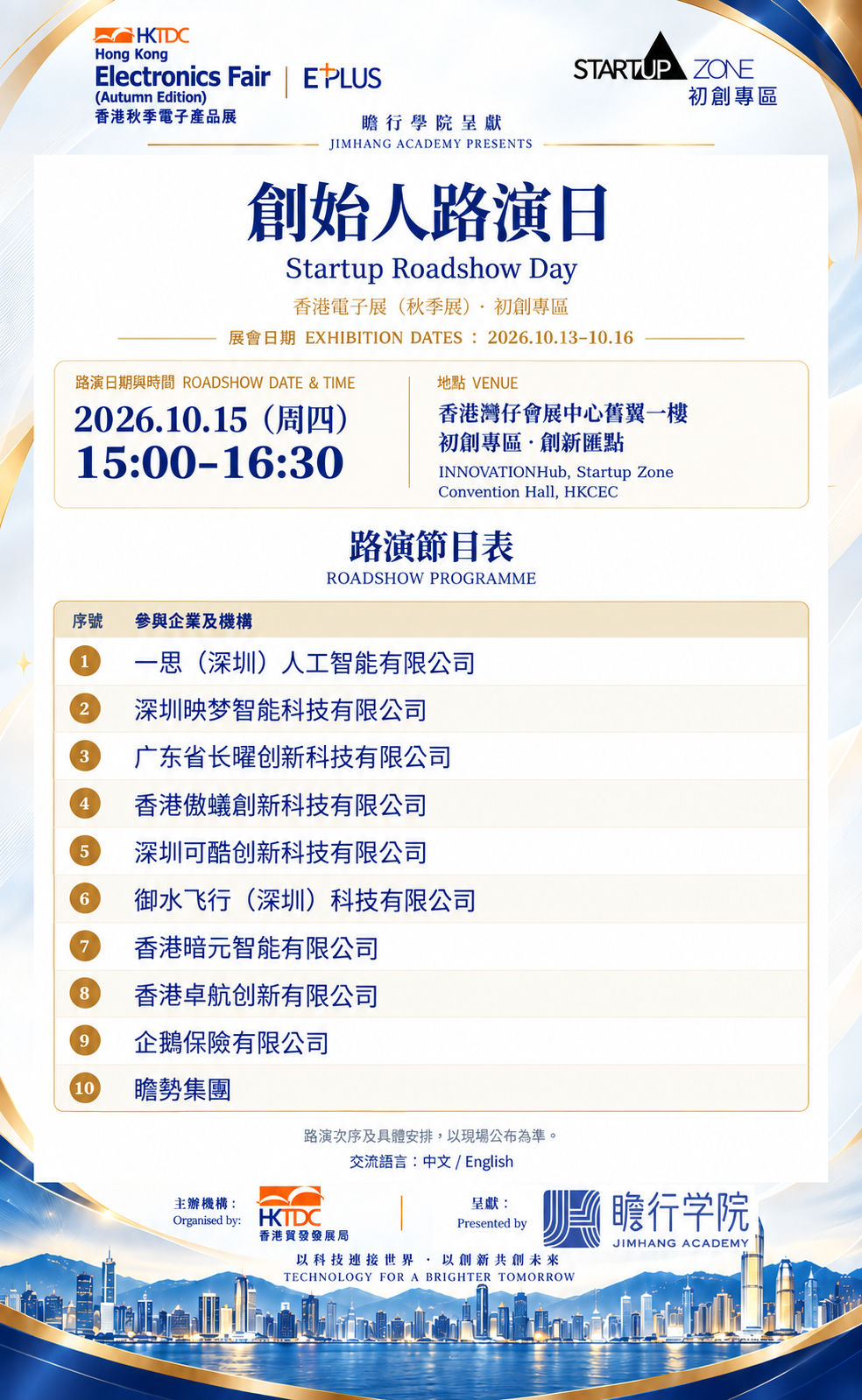
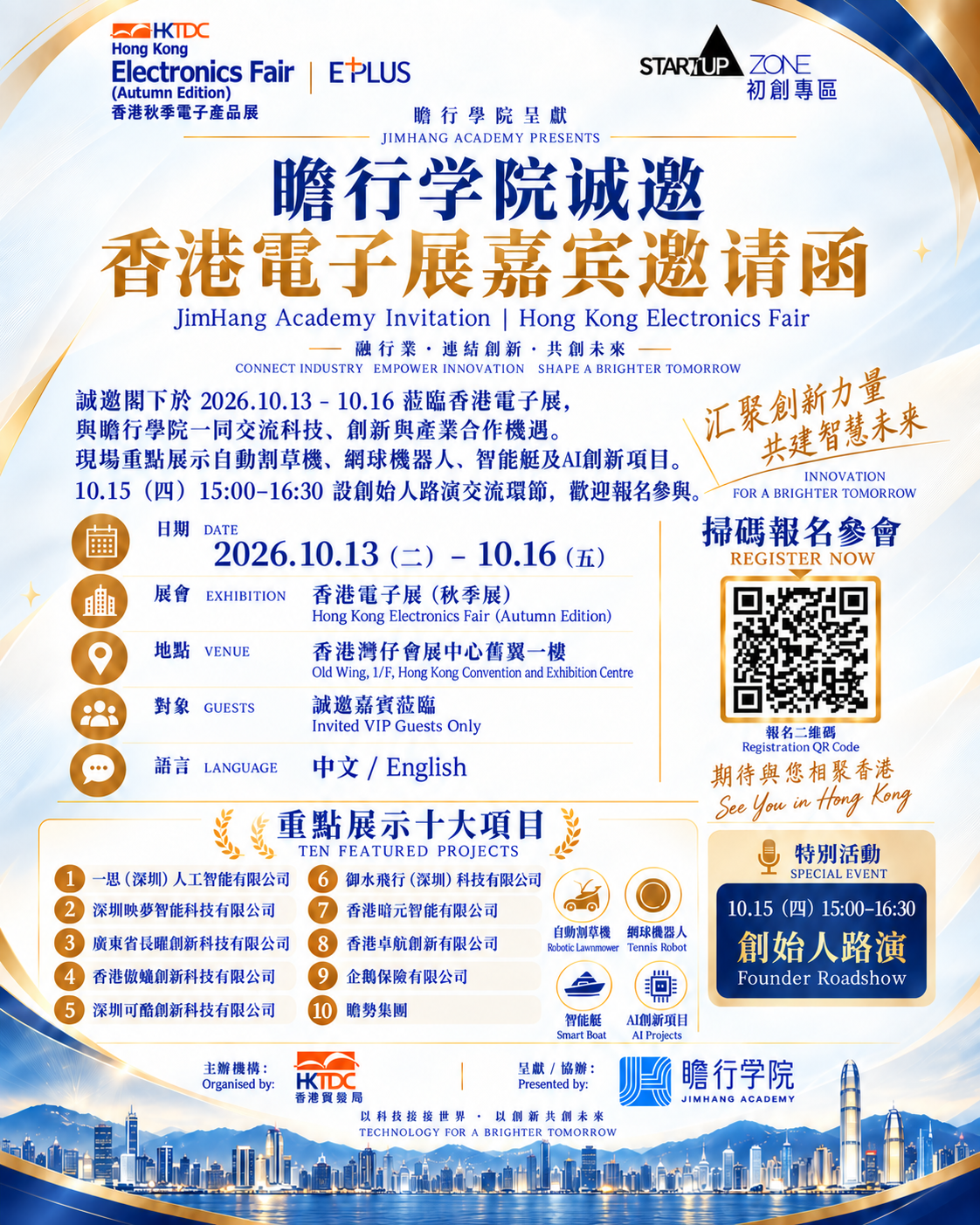
Event information and both original posters were supplied by Jimhang. HKTDC organises the exhibition; Jimhang Academy is identified on the posters as the roadshow presenter.