 monica
CREATIVE NOTES / Art & making
An Imaginary Travel Plan: Pictures and Ideas Sharing a Page
An Imaginary Travel Plan is not a neatly ruled itinerary. Zhan Yining (詹以宁), also known as Monica, fills the sheet with long-eared fantasy figures, tiny people, handwritten words and decorative shapes. A large central character commands attention. The page offers a chance to read pictures and writing together, while noticing what each leaves open.
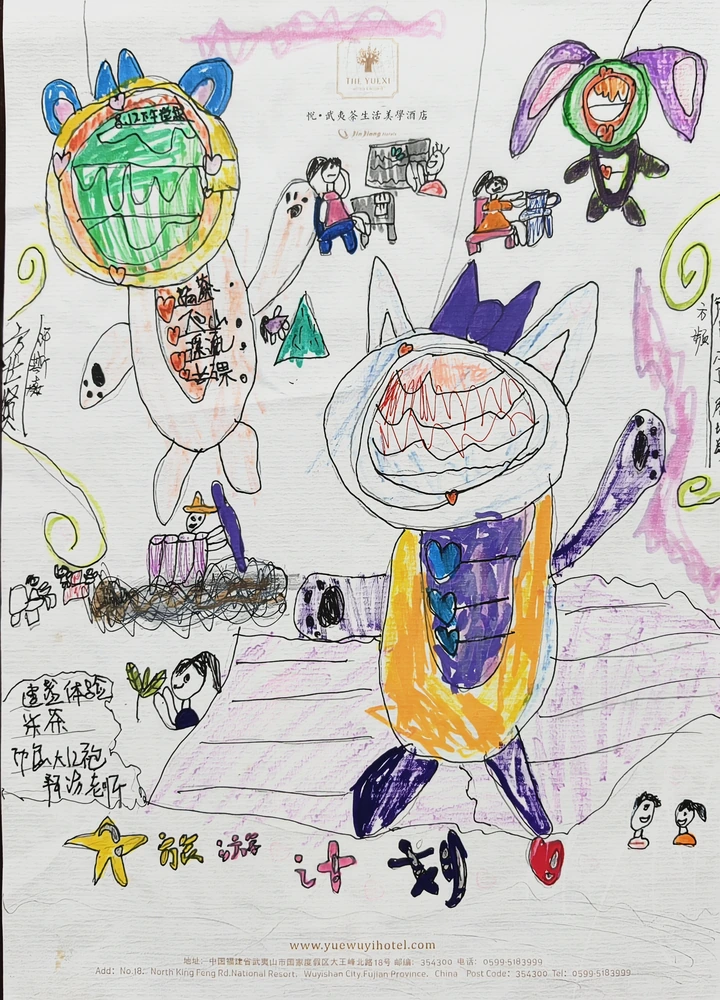
Large figures and tiny people create two scales
The figure near the centre-right has a large face, pointed ears, purple areas and an orange-yellow body carrying blue hearts. People around it are much smaller: some sit at tables, while others have simply drawn heads and bodies. The difference creates something like a main stage surrounded by short episodes. Moving from the large figure to the tiny people changes the scale of attention. Even without a sequence of comic panels, the page offers several distinct places to investigate.
Writing can belong inside the picture
The handwriting is not confined to a caption outside the drawing. Some words sit close to characters, others are enclosed by curved boundaries, and coloured lettering appears near the bottom. Their size, direction and surrounding spaces contribute to the composition. Begin by noticing where the writing occurs, then read the clearly legible parts and compare them with nearby images. Words beside a character are easily read together with it, while an enclosing boundary gives a note its own small place within the busy page.
Viewers can choose their own route
No clear route requires the viewer to move from upper left to lower right. You might start with the largest character, move towards a tiny person above it, or enter through the writing at the lower left. Different starting points bring the fragments together in different orders. Begin again somewhere else and a small figure previously overlooked may become the centre of attention. Treat the page as a map of ideas and try several routes, noticing colours, shapes or words that connect nearby fragments.
Make a map of your own ideas
To make your own idea map, draw an imagined place or character in the middle and add three small scenes around it, each with one short sentence. Let the drawing show an action and use the words for something less easily pictured, such as a question or an item to bring. Invite someone else to read the page in their own order. Notice which fragments connect most readily. The exercise explores how pictures and words share a task while allowing some ideas to remain unfinished.
Two more questions
How does the drawing gather so many ideas?
Large fantasy figures offer prominent entry points, while tiny people and writing form surrounding fragments. Viewers can move back and forth between these different scales of information.
Must every handwritten word be deciphered?
No. Comparing figure sizes, text placement and the relationships between fragments already shows how the sheet gathers many ideas into one space.
Explore the works in this note
Profile information was supplied by her family. These notes were prepared by the Monica portfolio editorial team from the original works, performance records and playable projects on this site, with AI-assisted writing and translation. Descriptions of existing work are distinguished from activities readers may try. The articles are editorial introductions, not first-person accounts written by Monica.
Profile and editorial notes →