 monica
CREATIVE NOTES / Coding & playful learning
Does a leaning sail need more cloth?
A triangular sail leans farther over. Its sloping edge looks longer, but must its area be larger? The Sail Area Mystery, a collaborative learning lesson on Zhan Yining’s website, places that misunderstanding inside a shipyard order. Gloop the robot wants to charge for more cloth, while Peach asks the reader to check the measurements. This third lesson in Monica’s Story Lab asks what changes with the outline and what stays fixed.
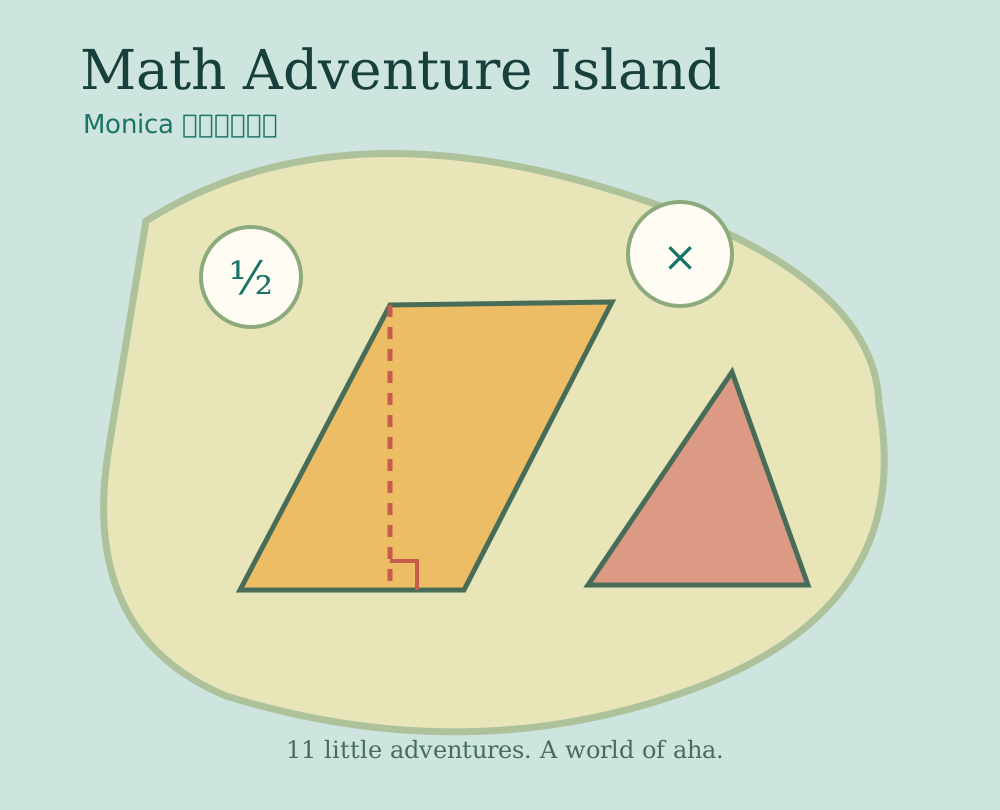
Choose a base before finding its height
The opening activity offers inside, outside and rotated diagrams. An orange edge marks the chosen base. From its opposite vertex, find the segment perpendicular to that base or its extended line. A longer sloping side cannot replace this height. Turn the diagram and the base may become vertical while the height runs horizontally. Height describes a relationship, not which line points upward on the screen. Extending the line locates the foot of the perpendicular; it does not lengthen the triangle’s base.
Slide along one parallel line
The sail lab fixes the base at 8 centimetres and the perpendicular height at 5. Its top vertex moves only along the upper horizontal line. Slide it left until the height falls outside the sail: the dashed line changes position but remains 5 centimetres long. The area stays 8 × 5 ÷ 2 = 20 square centimetres. Predict first, then compare two positions and the distance between the parallel lines. The conclusion depends on the fixed base and height, not on every possible way of moving a triangle.
A matching copy explains the factor of one half
Use the copy button and joining slider to assemble two congruent triangles into a parallelogram. Its base remains 8 centimetres and its height 5, giving an area of 40 square centimetres. One triangle therefore occupies 20. The copy is neither stretched nor shrunk, and the completed arrangement has no overlap or gap. Those relationships justify the half. Try covering the formula, pointing out the matching pieces and parallel sides, then explaining the division in your own words.
One area can have different dimension pairs
The sailmaker’s order reverses the question: each sail needs an area of 24 square centimetres. What base and height will work? Their product must be 48, so try 6 and 8 centimetres, or 12 and 4. Both pairs fit, and the page lets you check and record designs. This distinguishes changing a slant from changing dimensions. The earlier experiment held base and height fixed; here both may change while their product still gives the requested area.
Take the parallel lines onto paper
Draw two parallel lines on paper, fix two points on the lower line as a base, and choose three different vertices on the upper line. Compare the outlines before explaining their equal areas. Trace a matching copy of one triangle, turn it halfway around and try joining it. Back on the page, six core questions and two optional extensions include rotated figures, composite areas and a missing height. Activity stamps record completion; your explanation shows which mathematical relationship you can carry into another problem.
Two more questions
Can a height outside the triangle be used?
Yes. It must run from the opposite vertex perpendicular to the line containing the chosen base. Use the original side length as the base.
Does equal area mean identical sail shapes?
No. Triangles with equal bases and heights may have different slants, and different base-height pairs may also give equal areas.
Explore the works in this note
Profile information was supplied by her family. These notes were prepared by the Monica portfolio editorial team from the original works, performance records and playable projects on this site, with AI-assisted writing and translation. Descriptions of existing work are distinguished from activities readers may try. The articles are editorial introductions, not first-person accounts written by Monica.
Profile and editorial notes →