 monica
CREATIVE NOTES / Coding & playful learning
If the Stirred Cup Wins, How Do We Know Stirring Helped?
Gloop wants warmer water, more water and energetic stirring in one cup. If that cup finishes first, which change deserves the credit? The missing-sugar lesson on Monica’s website turns this question into settings that a reader can inspect. This editorial analysis of the collaborative learning project asks how to isolate one question before drawing a conclusion. It does not report a physical experiment conducted by Zhan Yining.
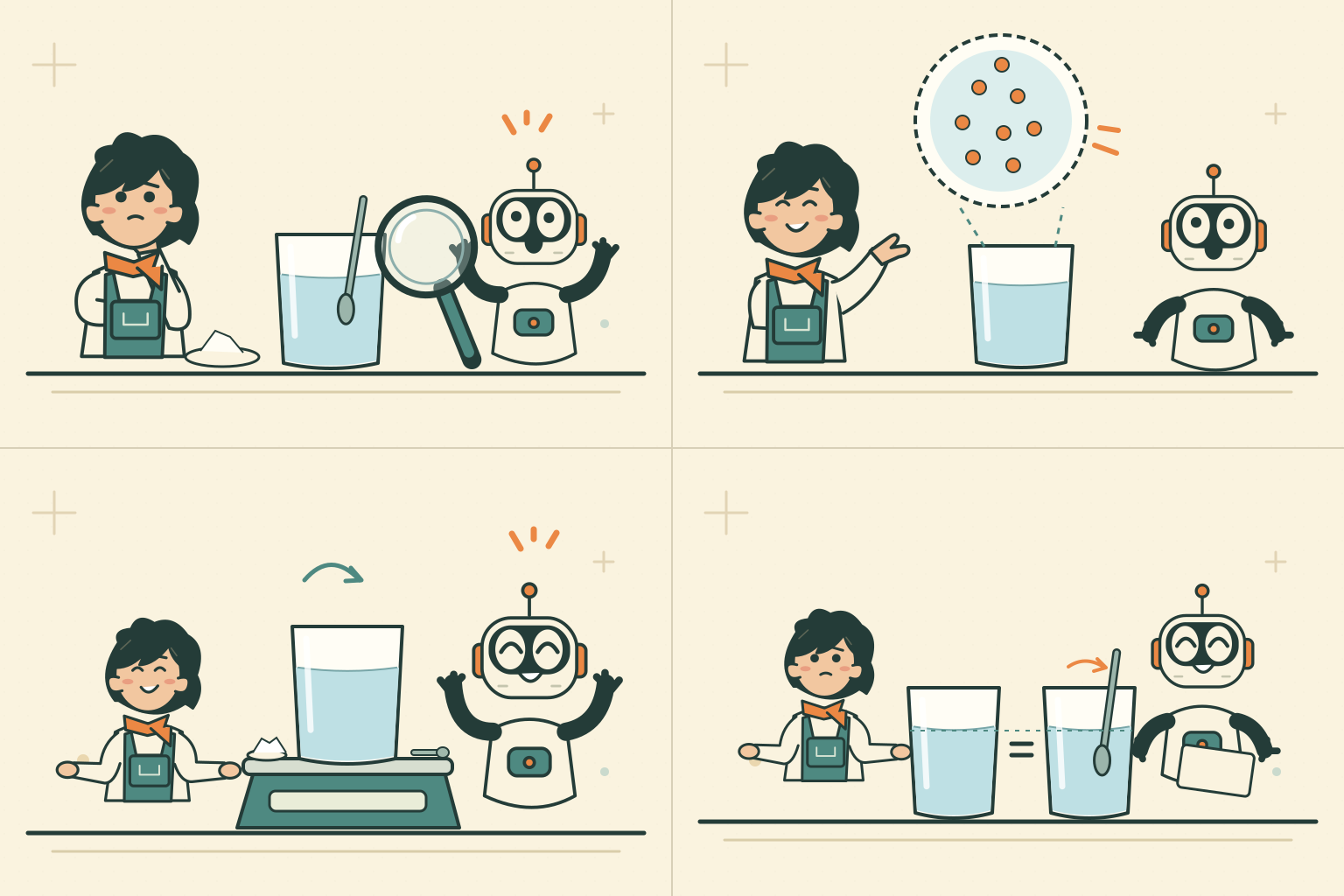
Begin with the question about stirring
To investigate stirring, compare whether the cups are stirred, rather than which cup receives more changes. The page fixes Cup A at 100 g of water, 10 g of the same fine sugar and 20°C, without stirring; readers arrange Cup B. Its instructions also specify matching containers and a simultaneous start. These details turn fairness from a broad intention into a set of conditions that can be checked.
Identify the matching conditions before the difference
The fair setting gives Cup B the same 100 g of water, 10 g of sugar, 20°C temperature and fine grain size, changing only stirring. If water temperature and quantity also change, finishing order cannot isolate stirring’s contribution. The particular numbers are this lesson’s baseline, not the only valid quantities for every dissolving investigation. What matters is keeping the other relevant conditions consistent for the question being tested.
Faster does not answer how much can dissolve
Both cups in this lesson eventually dissolve 10 g, so the comparison concerns speed, not their maximum capacity. With the same sugar and water at the same temperature and water quantity, stirring alone does not increase the saturation limit. The University of Wisconsin chemistry tutorial distinguishes dissolving rate from capacity and explains that stirring accelerates dissolving. A conclusion about finishing first under the tested conditions stays closer to the evidence than a claim that the water can hold more sugar.
Read the animation as an explanation, not a stopwatch
The progress bar illustrates order. Its percentages are neither elapsed seconds from a physical experiment nor measured quantities of dissolved sugar. A leading animated cup does not establish a fixed number of seconds or a constant speed multiplier. A physical comparison would also need a defined endpoint, actual timing and repeated observations. The program supports reasoning about arrangements and explanations; real measurements are still needed for real data, even when AI helps create an illustration.
Write a repair note for an unfair arrangement
Before running the model, list water quantity, sugar quantity, temperature, grain size and stirring for both cups. Circle every difference, choose the one you intend to investigate and match the others. Add a prediction and a conclusion limited to the comparison. This editor-suggested exercise suits upper-primary discussion and can inform other comparisons, such as paper-plane designs. Its aim is to explain the evidence, rather than simply guess the animation’s winner.
Two more questions
Does changing only stirring complete the scientific investigation?
It addresses the lesson’s core control problem. A physical investigation still needs consistent handling, a defined endpoint, measurements and repetition.
Does the page measure how many seconds stirring saves?
No. Its existing animation illustrates order; progress is not measured time.
Explore the works in this note
Scientific references
Profile information was supplied by her family. These notes were prepared by the Monica portfolio editorial team from the original works, performance records and playable projects on this site, with AI-assisted writing and translation. Descriptions of existing work are distinguished from activities readers may try. The articles are editorial introductions, not first-person accounts written by Monica.
Profile and editorial notes →