 monica
CREATIVE NOTES / Art & making
One Vase, Two Surfaces: Looking Closely at Monica’s Sketch with Tape
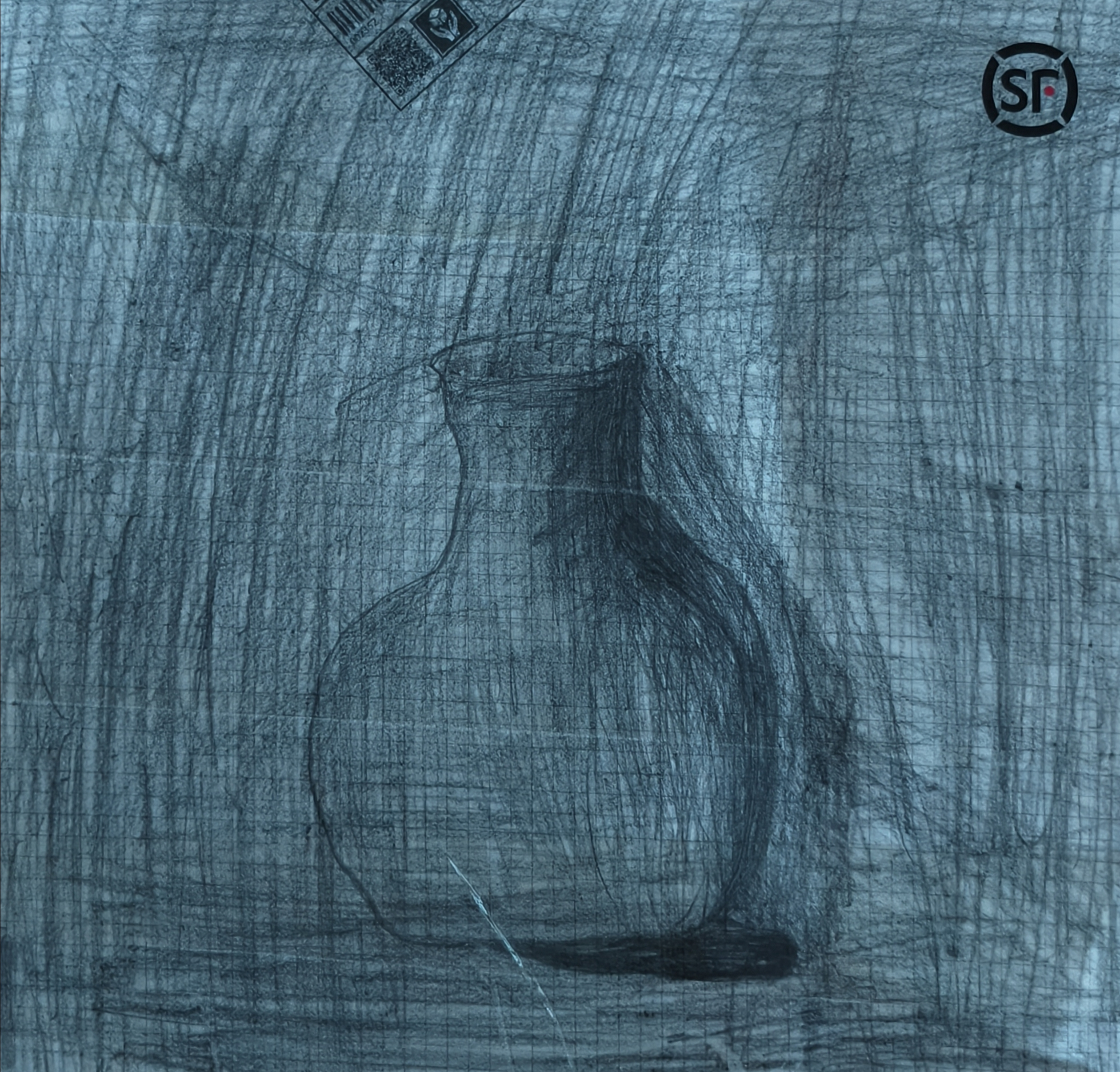
A vase stands among dense drawn lines, while an SF Express marking appears near the upper right. The eye moves into the drawing’s suggested space, then returns to the material covering it. As of October 2026, Zhan Yining (詹以宁), also known as Monica, is a Primary 5 student in Hong Kong. Her work page records a sketch followed by wrapping with packing tape. This editorial reading starts with the vase, then examines the surface through which we see it.
Follow the outline through its changes of direction
The opening spreads sideways into a shallow oval. Below it, the neck narrows before the shoulders widen into a fuller body. That sequence of wide, narrow and wide is easier to recognise at first than individual marks. Follow the left edge down, then return along the right edge towards the opening. Neither side is a simple straight line. Changes around the shoulders and belly give the flat outline recognisable features, even before we examine the shading inside it.
Shading carries the curve inside the outline
The area towards the left of the body’s centre is lighter, while the right side carries noticeably denser, darker marks. The neck also contains a dark area. Moving from the lighter region towards the right suggests a surface turning away to the side. Compare changes between neighbouring areas instead of dividing the rounded body into flat faces. At the base, a dark patch meets the vase’s base and extends rightwards. Separating that patch from shading on the vase helps distinguish the object from the surface supporting it.
The background participates in the reading
The space around the vase is filled with long vertical strokes, diagonals and crossing marks. Lines also run through the lower part of the picture. In places, the marks outside the vase approach those within it, so the boundary is less clear-cut than a cut-paper silhouette. Choose a short stretch of shoulder to compare: where are the marks darker, where do they change direction, and where must you look carefully for the edge? The relationship between inside and outside contributes to the form.
Distinguish the actual covering from the drawn surface
Now attend to the photograph’s surface. Printed tape markings appear above the vase, alongside horizontal seam-like lines, uneven texture and bright traces across the image. These details pass over both the drawn object and its surroundings, adding the presence of another material. The shading describes space within the picture; reflections remind us of the work’s actual surface. Looking in two passes helps distinguish these effects instead of treating every bright trace as a highlight belonging to the vase.
A small exercise in looking at two surfaces
Draw two small frames on separate paper. In the first, note the positions of the opening, neck, shoulders and body, then mark one lighter and one darker area. In the second, record only visible tape printing, horizontal lines and bright traces. Compare the frames to check whether you have mixed details from different surfaces. There is no need to add tape to an artwork or fill in obscured areas. Finish with one sentence naming a visible detail that changed your first impression.
Two more questions
Does the blue-green photograph show the vase’s colour?
The photograph has an overall blue-green cast affecting both vase and background. It does not establish the local colour of the depicted object. For volume, begin by comparing relative light and dark.
Should I begin with the drawing or the tape?
Either order works. Following the outline before examining the tape helps separate the layers. Reversing the order brings the covering material forward. Compare what you notice first each time.
Explore the works in this note
Profile information was supplied by her family. These notes were prepared by the Monica portfolio editorial team from the original works, performance records and playable projects on this site, with AI-assisted writing and translation. Descriptions of existing work are distinguished from activities readers may try. The articles are editorial introductions, not first-person accounts written by Monica.
Profile and editorial notes →