 monica
CREATIVE NOTES / Coding & playful learning
What is behind the paper strips? Monica’s Moca Surprise Draw
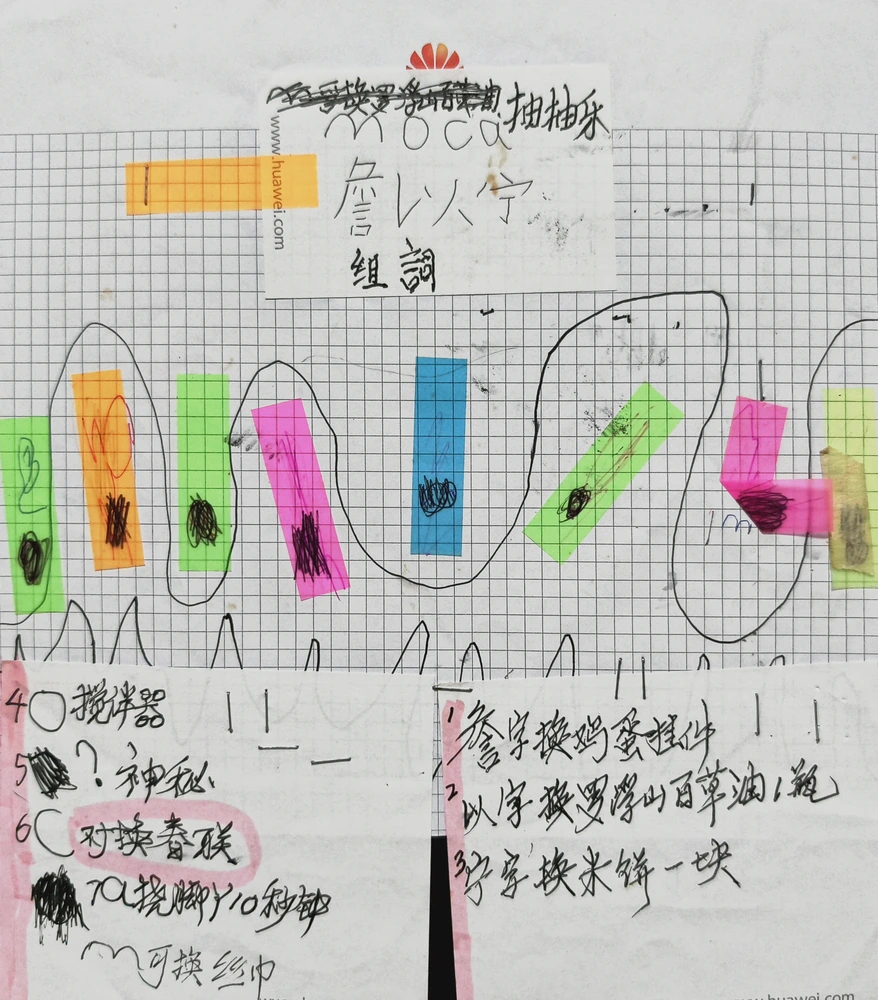
Green, orange, pink and blue strips sit on squared paper, with black lines winding between them. Above are the words “moca”, “surprise draw” and a reference to forming words; below are handwritten notes. Moca Surprise Draw by Zhan Yining, known as Monica, records a game idea taking a visible, paper-based form.
A title gives the game an entrance
A separate piece of paper at the top works like a little sign. English lettering, Chinese characters and crossed-out marks share the space. It feels handwritten rather than typeset. The draw-game title suggests choosing and revealing, while the word-building label introduces language as another part of the idea. Before we know every rule, the heading already changes how we read the sheet: the coloured pieces may have roles to play, rather than simply serving as decoration.
Colour makes the choices visible
Most of the coloured strips run vertically, though some tilt or bend. Their bright colours stand apart from the fine grey grid, making individual pieces easy to pick out. Marks on the strips and curving lines around them add a sense of activity. The photograph can be read as several layers of information: the squared sheet provides a field, the colours distinguish potential choices and the handwriting adds meaning. Recognising these layers is more useful than treating every mark as the same kind of instruction. Thick black lines and the fine grid offer different visual cues: one suggests a route, while the other helps compare positions.
Surprises need something to explain them
The lower notes contain numbers, letters, a question mark and a list of written items. A reference to something mysterious preserves the possibility of a surprise, while lists give some outcomes a place where they can be found. The photograph does not establish a complete playable rule set or the chance of each result. What it does show is a practical design problem: after making a choice, a participant needs to know where to look next. Surprise and explanation have to share the same sheet.
The handwritten surface is worth keeping
Paper edges, attached notes, crossed-out writing and varied pen pressure remain in the record. They make the object readable as a handmade sheet, not only as a set of abstract rules. For someone developing a different paper game, one useful starting point is to separate its name, available choices and instructions, then invite a reader to try following them. Monica’s own page preserves the actual object, including details that a polished redesign might otherwise erase.
Two more questions
Can the full game be reconstructed from the photograph?
The image records the title, strips and some instructions, but does not establish every rule, drawing method or probability.
Is Moca an online game?
This work is documented as physical paper-game design. It is separate from the playable digital games on the website.
Explore the works in this note
Profile information was supplied by her family. These notes were prepared by the Monica portfolio editorial team from the original works, performance records and playable projects on this site, with AI-assisted writing and translation. Descriptions of existing work are distinguished from activities readers may try. The articles are editorial introductions, not first-person accounts written by Monica.
Profile and editorial notes →