 monica
CREATIVE NOTES / Coding & playful learning
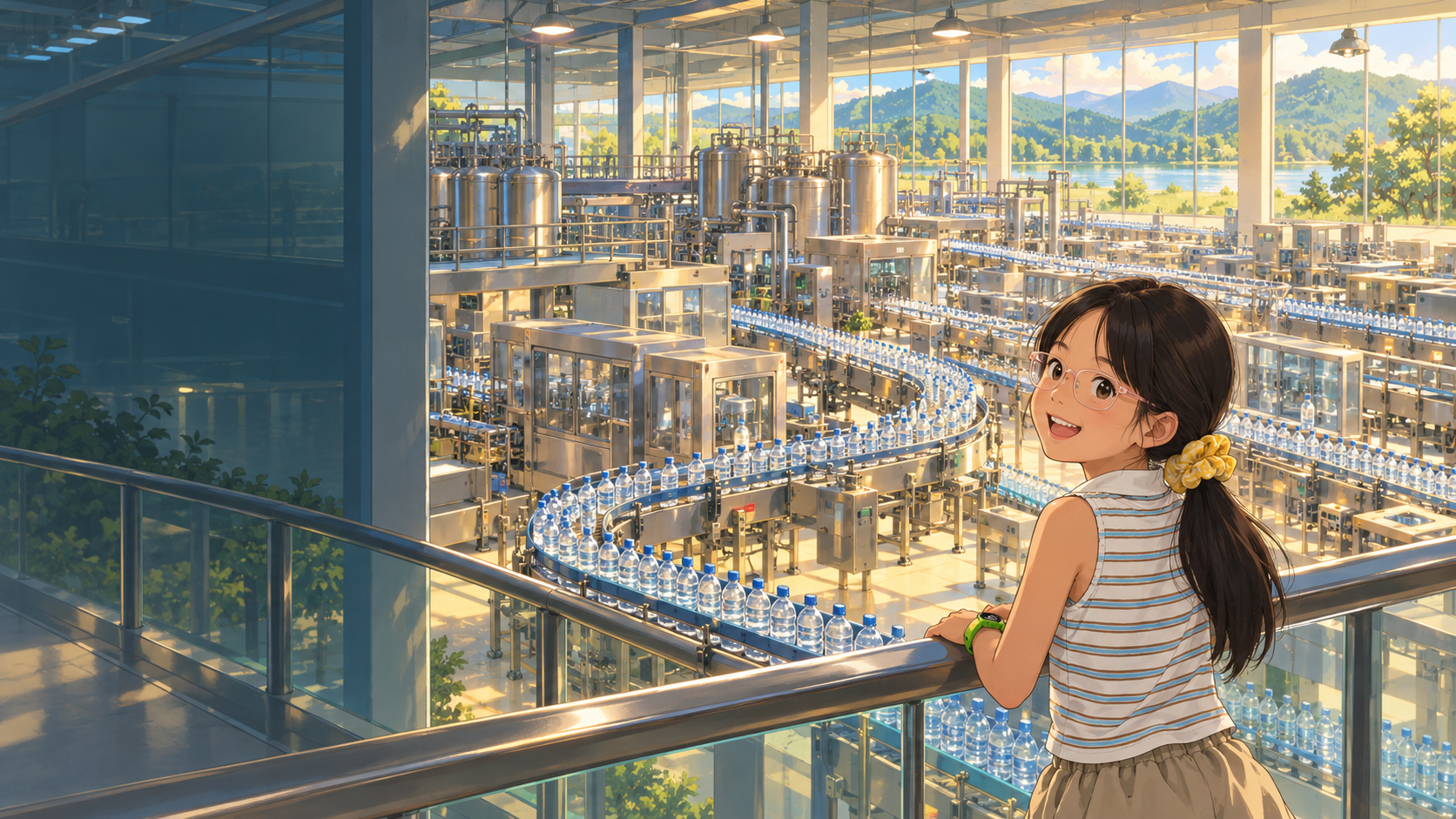
The water looks clear. Why does the production line continue?
A glass of water looks clear, yet more equipment waits ahead. In One Little Drop, a collaborative learning game on Zhan Yining’s website, where she is known as Monica, eight stages open up that question. Rather than memorising names, open the process field guide and ask what each station does. This article reads the interface as a simplified model of different responsibilities; real drinking-water safety requires appropriate treatment and testing.
Read the route before returning to the source
The current route is source care, sand filtration, carbon adsorption, membrane filtration, disinfection, hygienic filling, cap and label, then inspect and pack. The first station asks the player to clear litter before choosing the batch’s water withdrawal. Its position makes a useful point: caring for the source belongs within the process. More machines later do not make the starting point irrelevant. The field guide lets readers move backwards and forwards, so they can see the route before studying one station.
Different filters, different jobs
In the sand-filter diagram, suspended particles are trapped. The carbon station introduces adsorption of some odor-causing substances and organic compounds, with attention to media condition and contact time. The membrane station explains that removal depends on membrane type. Trapping, adsorption and passage through a membrane cannot be compressed into “everything disappears”. Compare what the three diagrams leave behind, then read the limits stated in their notes. A clearer appearance answers only part of the question.
Treatment must connect to hygienic filling
The fifth station gives disinfection its own place, making its role distinct from filtration. Green ranges and simulated timings indicate completion within the game; they are game settings. The sixth station moves on to bottle preparation, a hygiene check and filling three sample bottles. The question has changed from which treatment water receives to how it enters a bottle. Underfilling requires rework, while overfilling wastes water. Completing the earlier station does not make the next one unnecessary.
The final checks go beyond appearance
Cap and label checks the closure, batch code and label position. The label helps identify the product and provides a traceability clue. Inspect and pack then asks players to select the cracked and underfilled bottles and confirm recycling for packaging scraps. Separate those tasks: inspect the bottle, deal with defects and decide where materials go. The guide also explains that visual inspection is only one part of quality assurance. An attractive label or an apparently intact bottle cannot replace real testing.
A reader exercise: one question on each card
Make eight paper cards, each with a stage name, the question it addresses and something that later steps must still establish. A sand-filter card might ask which particles are trapped; an inspection card might ask which sample bottles need rework. Arrange them in the website’s order and explain why another station follows clearer-looking water. Return to the guide when unsure. This is a reading and classification exercise, without making drinking water at home or treating game values as experimental conditions.
Two more questions
Do all bottled-water factories use these eight stages?
This is the game’s simplified route. Actual processes depend on the source, equipment and treatment requirements; it is not a brand’s complete process specification.
Can I read the guide without finishing the three-day campaign?
Yes. The guide can be explored without advancing production, and the workbench also offers individual-stage practice.
Explore the works in this note
Scientific references
Profile information was supplied by her family. These notes were prepared by the Monica portfolio editorial team from the original works, performance records and playable projects on this site, with AI-assisted writing and translation. Descriptions of existing work are distinguished from activities readers may try. The articles are editorial introductions, not first-person accounts written by Monica.
Profile and editorial notes →