
Begin with the scope of the figures
HKTDC's 16 October closing announcement gives combined figures for the two fairs and describes 130 buying missions involving buyers from 65 countries and regions. These are platform-wide figures, not attendance at the Jimhang showcase, and not enquiries, orders or funding results achieved by an individual exhibitor.
The geographic reach supports the view that Hong Kong provides a meeting point across markets. It does not, by itself, establish which country will buy a particular product. That question requires a team's own product and business evidence.
International reach is not a target-market list
A tennis-training product, a garden robot and an enterprise software platform may have very different users and channels. Appearing at the same fair does not give them the same international-expansion roadmap.
Start with a specific application: where the product will be used, who will pay, and who will demonstrate, deliver and support it. Without those roles, adding more countries can make a market list longer without clarifying where a small team should invest first.
What separates a platform signal from a project decision?
| Information available | What it helps explain | What it does not establish |
|---|---|---|
| More than 61,000 buyers across both fairs | The scale of the overall trading platform | An equivalent number of prospects for one project |
| Buyers from 141 countries and regions | Breadth of international market contact | Product suitability in every market |
| Organised buying missions | A mechanism for procurement conversations | Purchase commitments from participants |
| A team's own application feedback | Specific user and channel questions | Revenue from demand that remains unverified |
The first three items come from the organiser's announcement. The final item is evidence a team must organise for itself. Keep them separate in a project update: general industry interest should not be presented as product validation.
Separate buyer interest from investment interest
Buyers ask whether a product serves their users, whether it can be delivered, and how support will work. Investment conversations also require an understanding of the team, business model and development stage. Procurement and capital discussions can inform each other, but willingness to examine a product is not an investment commitment.
An overseas investor meeting Greater Bay Area teams through Hong Kong can start with products and applications, then request business information within an agreed scope. Founders should clarify whether a contact is discussing procurement, distribution, industry collaboration or investment, rather than describing every contact as a source of capital.
Hong Kong-Shenzhen cooperation: decide what to validate next
After the fair, a useful question is where the next allocation of time and budget belongs. Should a team improve a demonstration for one target market, look for a local support partner, explore a specific application further, or defer entry into an unfamiliar market?
These are choices, not universal answers. Hong Kong's international meeting point and the product, engineering and supply-chain work of Shenzhen and the wider Greater Bay Area can connect around one bounded validation task. Specify the question, resource limits and evidence needed before deciding whether to expand. A large fair is not a reason to enter too many markets simultaneously.
Jimhang Going Global: keep the project information useful
The Jimhang fair feature retains profiles of ten teams and organisations, their booths for this edition and the original event posters. Booth information now forms part of the event archive, not a current invitation to attend. Further introductions can begin with a product direction and a concrete cooperation question.
Jimhang Capital and Jimhang Academy welcome discussions about project communication, industry resources, supply-chain coordination and entrepreneurship support. Buyers and investment partners looking to understand Greater Bay Area teams through Hong Kong can contact Justin Zhan / Jimhang Capital, outlining the product area, target market and type of collaboration they wish to discuss.
For an existing project conversation, see the separate fair follow-up guide and professional-services guide. This article interprets newly published closing figures; it does not replace project diligence, procurement validation or individual investment advice.
Figures are HKTDC's combined two-fair totals published on 16 October 2026, checked on 17 October. Market-selection and coordination suggestions are editorial analysis.
This edition’s fair and roadshow archive
- Exhibition
- 13–16 October 2026 · Hong Kong Electronics Fair (Autumn Edition)
- Founder roadshow
- Thursday, 15 October 2026 · 15:00–16:30 Hong Kong time
- Roadshow venue
- INNOVATIONHub, Startup Zone, Convention Hall, Old Wing 1/F, Hong Kong Convention and Exhibition Centre, Wan Chai
The physical fair ended on 16 October 2026. The published schedule and original posters are retained as event materials, not current registration or attendance invitations. Original QR codes remain unchanged. Contact Jimhang for further collaboration; actual event outcomes require separately verified reporting.
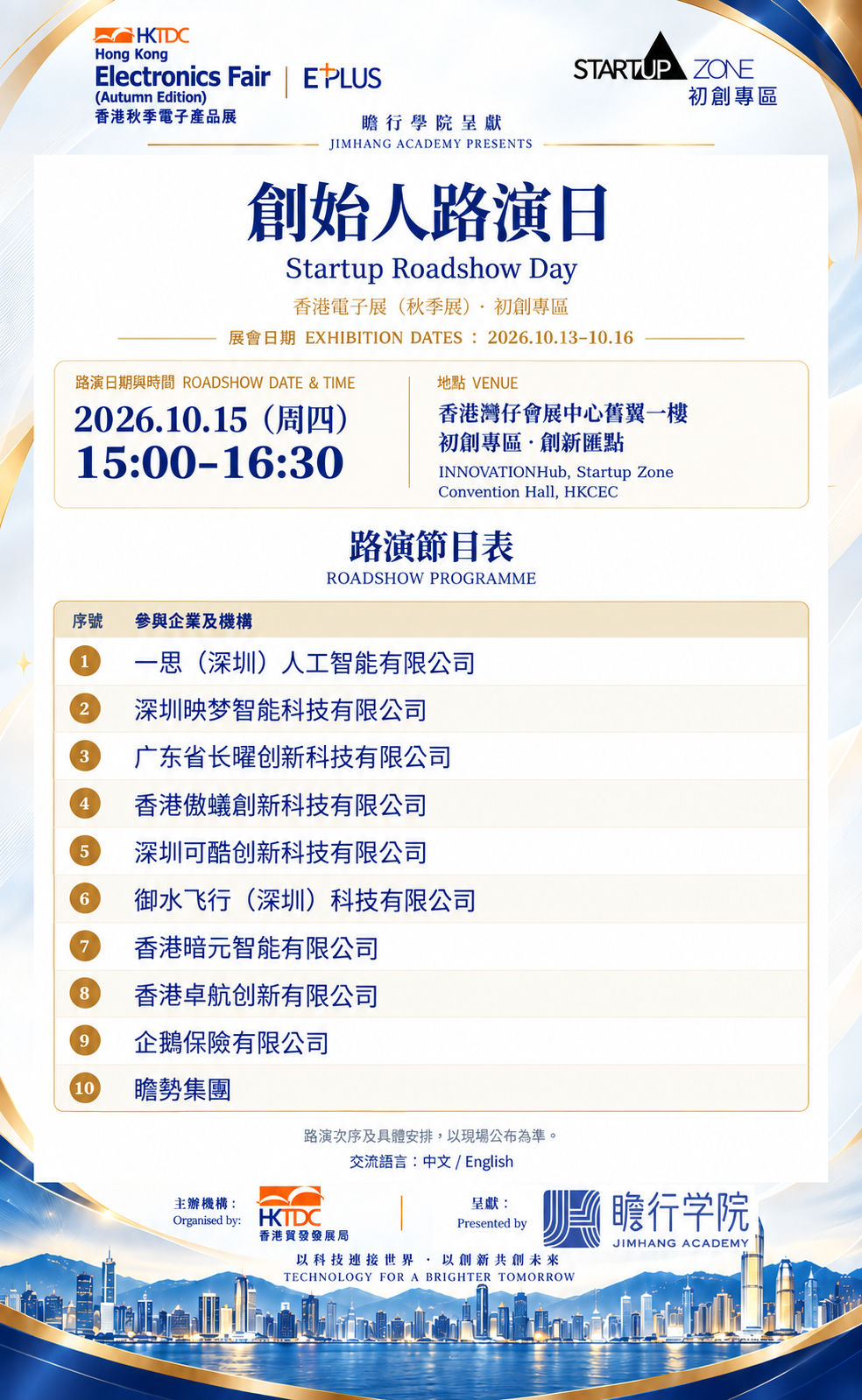
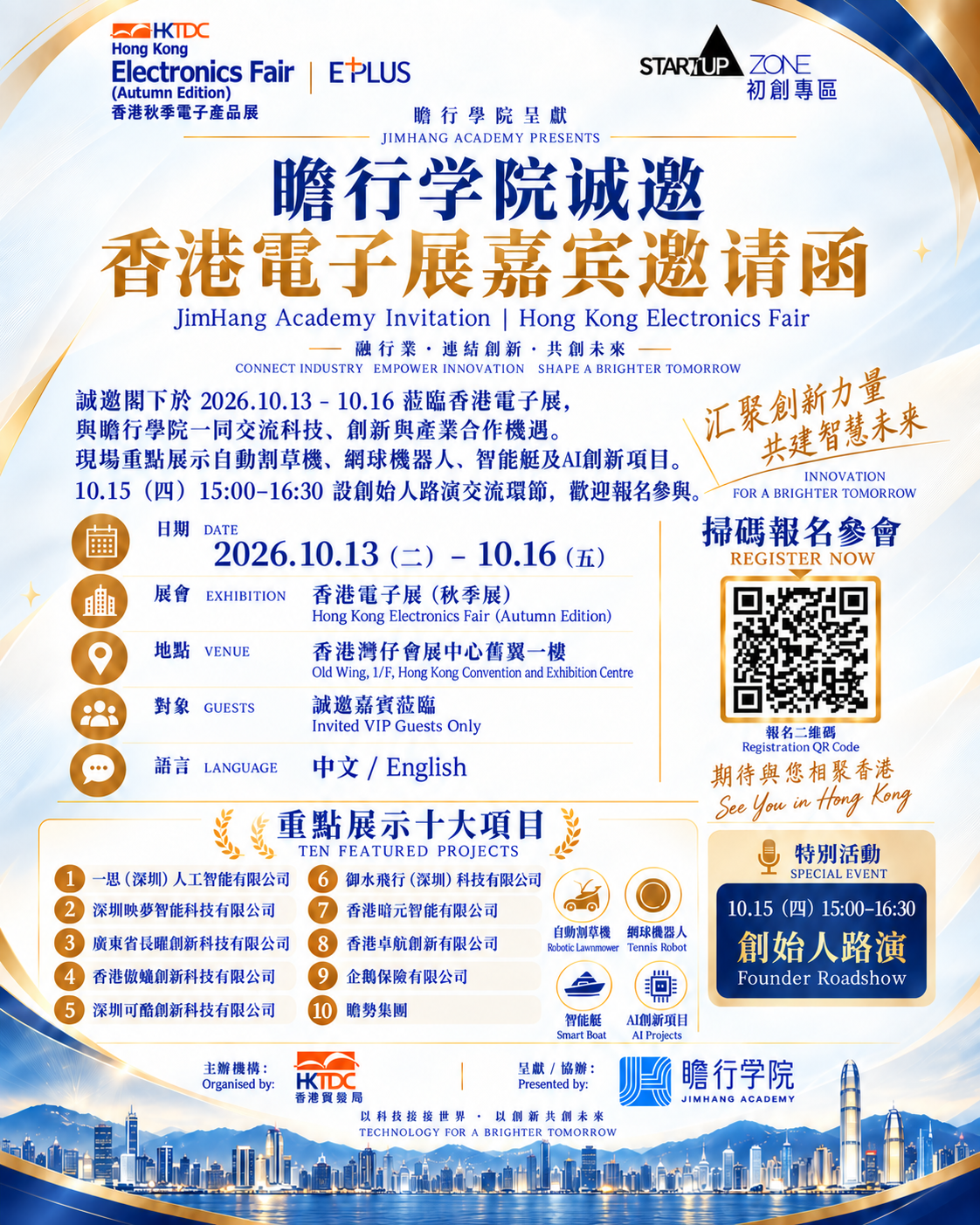
Event information and both original posters were supplied by Jimhang. HKTDC organises the exhibition; Jimhang Academy is identified on the posters as the roadshow presenter.