 monica
CREATIVE NOTES / Coding & playful learning
The hiding places that became a game: Monica’s Hideout Club
Zhan Yining, known as Monica, is a Primary 5 pupil in Hong Kong as of October 2026. She loved hide-and-seek from childhood, surprising her family with unexpected places at home and later playing with Grandpa around their residential neighbourhood. She wondered whether vibe coding could turn that familiar pleasure into a game. Hands-on coding with AI assistance led to the playable Hideout Club on her website.
Finding surprise in a familiar home
Her family remembers hiding places under a sofa or inside a wardrobe that adults did not immediately think to check. The charm of the memory lies in the different ways a child and an adult can notice the same room. Familiar furniture becomes part of a small mystery. The family’s recollections give her later game idea a personal starting point: the pleasure of surprising someone who knows the space, yet has not guessed where she might be.
A new setting, with Grandpa
After the family moved, Monica often played hide-and-seek with Grandpa in their residential neighbourhood. The setting changed, while the pleasure of hiding and being found continued alongside familiar family companionship. Remembering Grandpa brings warmth to the story of a browser game. Beyond its digital worlds are people with whom she shared the real activity. Her interest in making the game connects to something she already enjoyed in everyday life.
From playing it to making it
Then she wondered whether she could make such a game through vibe coding. That question changes her role from player to creator. A website needs an entrance, ways to move and signals that explain what is happening. Hands-on coding with AI assistance provided a way to turn the idea into an interactive project. A familiar game now raised a new design question: how could the parts she enjoyed become rules that another person could understand and take part in?
Three worlds on the screen
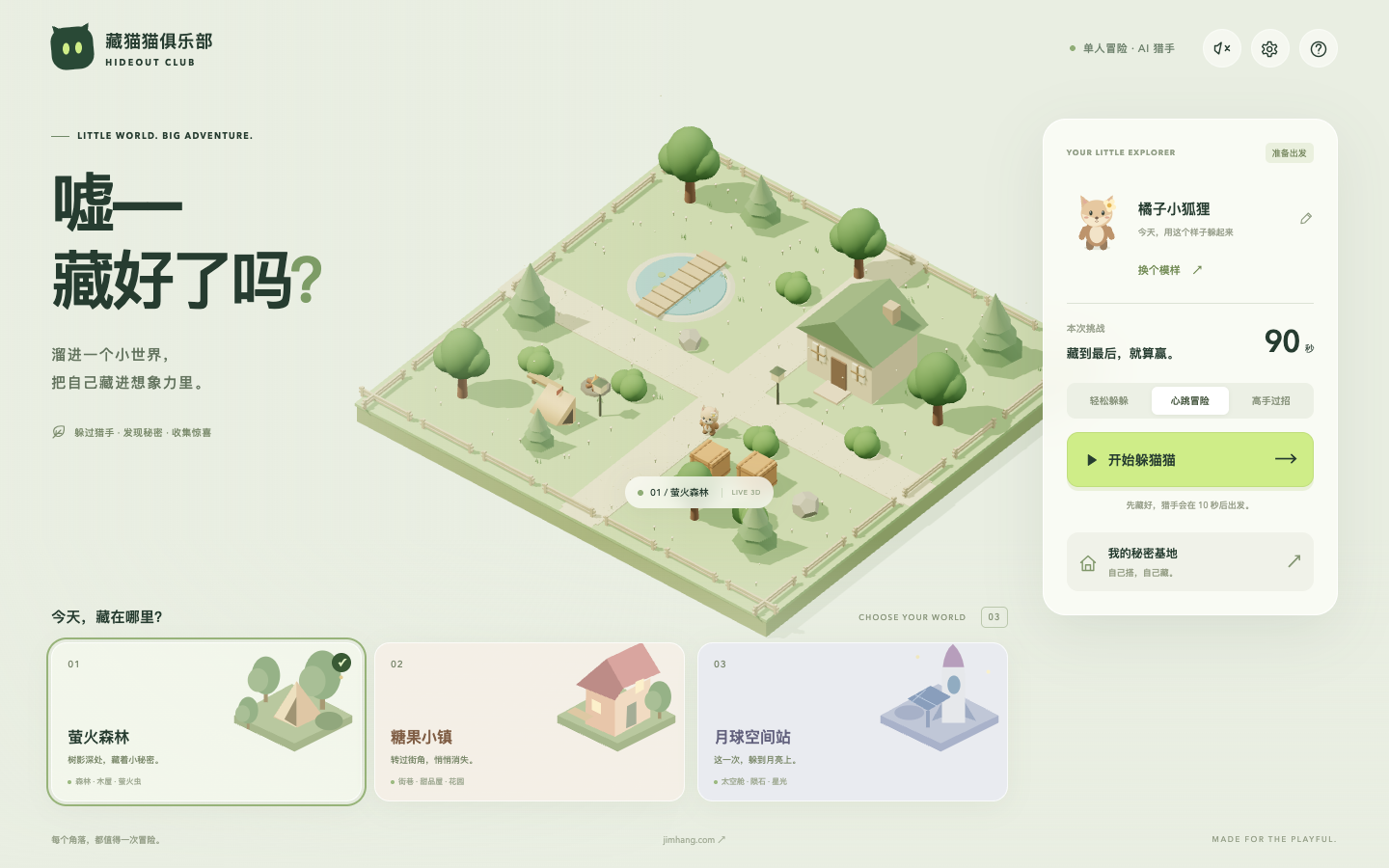
The published Hideout Club offers Firefly Forest, Candy Town and a lunar space station. It is a single-player game with computer-controlled hunters. A ten-second preparation period comes before a ninety-second survival challenge. Players can move, sprint, use designated hiding spots, collect stars and complete small tasks. These are the current game’s rules, rather than a reconstruction of Monica’s home or neighbourhood. The connection to childhood is the feeling of searching and being searched for, expressed through an imagined setting.
Making room for the next idea
The “My Hideout” builder adds another step: choosing objects, arranging a space and then playing in it. Hiding places and routes have to coexist. Someone who first enters as a player can also try making a setting. Read alongside the family story, this feature gives the project a warm continuity. Monica once found unexpected possibilities in places around her; now her website offers a little world in which visitors can look for possibilities of their own.
Two more questions
Why did she want to make a hide-and-seek game?
She had enjoyed hide-and-seek since childhood and shared it with her family and Grandpa. That lasting interest led her to explore making a playable world through vibe coding.
Can visitors play together online?
The current version is single-player, with computer-controlled hunters. The family playmates belong to the real-life story.
Explore the works in this note
Profile information was supplied by her family. These notes were prepared by the Monica portfolio editorial team from the original works, performance records and playable projects on this site, with AI-assisted writing and translation. Descriptions of existing work are distinguished from activities readers may try. The articles are editorial introductions, not first-person accounts written by Monica.
Profile and editorial notes →